


Magic doesn’t live in a shop. It doesn’t wait for you to buy the right candle, find the perfect crystal, or order a specific herb online. It lives in you — in your breath, your intention, your attention. Every witch who ever existed started with nothing but themselves, and that was always enough.
The truth is, the tools are just reminders. They help you focus, sure, but they’re not where the power comes from. You are. Your energy, your will, your connection to the world around you — that’s the real stuff. A crystal doesn’t make magic happen. You do. The crystal just gives your hands something to hold while your mind does the work.
Witchcraft is one of the oldest human practices on earth, and for most of that history, people were working with whatever they had — dirt, spit, moonlight, a whispered word. No Etsy haul required. Whether you’re brand new, completely broke, living with people who wouldn’t understand, or just in a moment where you have nothing on hand — this list is for you. These are real practices. They work. And they cost exactly nothing.
So if you’ve ever thought I can’t do magic right now because I don’t have my stuff — this is the article that changes that. Everything below can be done with your body, your mind, and the world immediately around you. No tools, no supplies, no altar. Just you, which was always the most powerful ingredient anyway.
1. Breathwork as a Spell

Your breath is the most underrated magical tool in existence — and it’s always with you. Every tradition that has ever touched the sacred has understood this: breath is the bridge between the physical and the unseen. Yogic traditions call it prana, the Chinese call it qi, the ancient Greeks called it pneuma — spirit and breath were the same word. What you breathe is not just air. It is the medium through which your will enters the world.
Slow, intentional breathing shifts your energy instantly — not metaphorically, but physically. When you breathe with deliberate rhythm, you activate your parasympathetic nervous system, lower your cortisol, and move your brain into the calm, receptive alpha-wave state that is, not coincidentally, also the state associated with deep focus, creativity, and what mystics have always called “the trance.” Magic doesn’t work well in panic. It works in stillness. And breath is how you get there.
The technique itself is simple: breathe in for four counts, pulling in what you want — calm, clarity, love, courage, whatever your working requires. Hold for four, feeling it accumulate. Breathe out for four, releasing what you’re ready to let go of. Do this seven times with full, unwavering focus. Seven is not arbitrary — it carries deep symbolic weight across nearly every magical tradition, and the mind responds to meaningful numbers whether or not it can explain why.
What makes this a spell and not just a breathing exercise is the intention. Anyone can slow their breathing down. What the witch does differently is hold something specific and wanted in mind with every single breath — not as a vague hope, but as a felt, embodied certainty. The breath becomes the vehicle. The intention is the cargo. By the seventh exhale, something in you has genuinely shifted, and that shift is the spell working.
2. Charge Water with Your Intentions

Fill a glass of tap water. It doesn’t need to be special water — well water, spring water, filtered water are all fine, but so is whatever comes from your kitchen tap. The magic here is not in the source of the water. It’s in what water is: the most receptive, mutable substance on Earth. Water has no fixed shape. It takes the form of whatever holds it. In the language of magical thinking, this makes it the perfect medium for holding intention.
Hold the glass in both hands and close your eyes. The two-handed grip matters — it closes the circuit between your left and right sides, and it brings more of your body into contact with what you’re working with. Now pour a specific, clear feeling into the water. Not a vague wish — a feeling. Gratitude that is actually felt in your chest. Healing that you can sense as warmth. Strength that sits in your shoulders. The more precisely you can generate the emotional state, the more effectively it transfers.
This practice is found across an extraordinary range of cultures and time periods. Holy water exists in nearly every tradition. Blessing water before drinking it appears in Indigenous American ceremonies, Japanese Shinto practice, Celtic folk magic, and Christian rites alike. Masaru Emoto’s controversial water crystal research — whatever you think of its methodology — spoke to something people have intuited for millennia: that water responds to what surrounds it, and that human intention is a real force in that environment.
Drink the water slowly and deliberately, feeling it move through you. The act of drinking something you’ve charged is an act of internalising your own intention — you’re quite literally taking your magic inside your body. Do this in the morning for a day you want to set the tone for, or when you’re unwell, or when you need something and feel helpless. The glass of water on your nightstand is already a ritual object. You just have to decide to treat it like one.
3. Use Your Gaze to Set an Intention

The occult traditions have always understood that the eyes are not passive receivers of light — they are active, projecting organs. The evil eye exists as a belief across Mediterranean, Middle Eastern, South Asian, and Latin American cultures precisely because people have always understood, at some intuitive level, that the gaze carries charge. When you look at something with full, undivided attention and a clear emotional state, something passes between you and the object of your focus. This is the foundation of what witches call “the working gaze.”
Pick a fixed point — a candle flame if you have one, a star through the window, the sun catching a wall at a particular angle, a spot on the horizon. The point you choose should be something you can hold your gaze on without strain. Now let your eyes go soft — not unfocused, but relaxed. You’re not staring hard. You’re settling into the point the way you settle into a chair. Let peripheral vision fall away. Let the background blur. Keep only the point.
Now bring your intention in. Not thoughts about the intention — not planning, not rehearsing, not explaining it to yourself. One word, one image, one feeling. If you want clarity, feel clarity. If you want protection, feel protected. If you want love, feel the warmth of it in your chest. Hold the gaze and hold the feeling simultaneously, and don’t look away until the feeling feels set — until it has moved from something you’re generating with effort into something that feels stable and real. That settling is what you’re waiting for.
This is the foundation of almost all manifestation practice, and it costs nothing but discipline. The hard part is keeping the mind from wandering into commentary — from “I am calm” sliding into “I wonder if I’m doing this right” sliding into a grocery list. When that happens, come back to the point and start again without judgment. The act of returning is itself part of the practice. It trains the mind to sustain intention the way physical exercise trains muscle to sustain load. Over time, the gaze becomes a tool you can deploy in seconds.
4. Moon Bathing

Step outside under the moonlight — or, if that’s not possible, sit by an open window where the light can fall on you. This is not a metaphor. You are putting your body in contact with the actual light of the actual moon, which carries actual information. The moon governs the tides. It exerts measurable gravitational pull on every body of water on Earth, including the water in your body, which makes up the majority of what you are. The moon is not a spiritual symbol that happens to look beautiful. It is a physical force that moves things.
The tradition of moon bathing is ancient and cross-cultural. Ayurvedic medicine prescribed moonlight exposure for cooling and calming conditions. Ancient Greek and Roman women performed moon rites under the open sky. Indigenous cultures across every continent have moon ceremonies. The witch understands that these weren’t primitive confusions about what the moon was — they were sophisticated observations about what the moon does. And what it does, at a biological and energetic level, is affect cycles: the tides, the menstrual cycle, animal migration, plant growth. It affects you whether you acknowledge it or not.
When you sit in moonlight with intention, you align yourself with the phase it’s in. The full moon is the time of fullness, completion, and drawing things toward you — it’s the moment of highest energetic charge. Sit in full moonlight and ask for something. Ask plainly, specifically, as you would ask a trusted and powerful friend. The waning moon — the days after full, when the light diminishes — is the time for releasing, for letting go of what no longer serves, for banishing. New moon is the time to plant seeds of what you want to grow. Understanding these cycles and working with them rather than randomly is one of the basic competencies of the working witch.
If it’s cloudy, you can still do this. The moon is there behind the clouds, and its energetic presence doesn’t depend on the light reaching your skin. If you can’t go outside safely, a windowsill works. The point is to be still, to be present, and to open yourself consciously to an influence that is already there. You don’t have to believe in it for it to work any more than you have to believe in gravity before you fall. Just sit. Let the night air touch your face. And say what you need.
5. Speak a Verbal Charm

Words are spells. This is not poetic license — the word “spell” itself comes from an Old English root meaning simply “to speak,” and across magical traditions worldwide, the spoken word is understood to be one of the most powerful tools available to a practitioner. The Vedic tradition built an entire science of sacred sound called mantra. Kabbalistic magic centres on the Hebrew alphabet as a generative force. Ancient Egyptian priests believed that to speak something’s true name was to hold power over it. Your words are not just sounds. They are declarations about the shape of reality.
A verbal charm is a spoken intention with rhythm and repetition. The rhythm matters because it bypasses the analytical mind — the part of you that keeps interrupting to ask if this is working. When words fall into a beat, the critical faculty relaxes and the deeper layers of the mind come forward. This is why all the world’s most ancient prayers, chants, and invocations rhyme, or have a strong metre, or both. Rhyme is not decoration. It’s technology. You can construct a charm on the spot: something simple like “I am safe, I am clear, only good may enter here” — three beats, two rhymes, direct statement. That’s all you need.
Say it three times. Three is the number of completion across most Western magical traditions — beginning, middle, end; past, present, future; body, mind, spirit. Say it aloud if you can, because the physical act of vocalisation — the breath, the vibration in your chest and throat — adds a bodily dimension that silent thought doesn’t have. If you can’t speak aloud, whisper it. If you can’t whisper, mouth it with full conviction. The more of your body you bring into the act, the more fully you’re committing the whole organism to the intention.
The most important element is this: say it like you mean it. Not like you’re reading a label. Not like you’re testing it to see if it works. Like you already know it to be true. The stance of the practitioner is not supplication — it is declaration. You are not asking for something to become real. You are naming what is already becoming real. That distinction in inner posture is everything. When you feel slightly ridiculous saying it the first time, say it again. By the third time, something shifts. It always does.
6. Ground Yourself Using Only Your Body

Grounding is one of the first things taught in almost every tradition of energy work, and for good reason — it is the foundation of everything else. An ungrounded practitioner is like an electrical circuit with no earth wire: unstable, prone to surges, unable to safely channel the power they’re working with. Before you cast, before you charge, before you visualise, you ground. And all it requires is your body and the Earth beneath it, because both are already there.
Stand or sit with your feet touching the floor — barefoot on grass, sand, or soil is ideal, but a wooden or concrete floor works, too. Close your eyes. Feel the weight of your body pressing down. Now, with your attention, trace the sensation from your feet downward — through the floor, through the foundations, into the soil beneath the building, and then deeper, into the bedrock, into the slow heat of the planet’s interior. Imagine roots growing from the soles of your feet, pushing down through all that distance, anchoring in the mass of the Earth itself. You are a tree. You are held.
Notice what changes. The mental static tends to quiet. The anxiety that floats in the chest tends to drop lower in the body, where it becomes more manageable. The sense of being scattered — of existing in your head, buzzing with thought — softens into something more whole. This is not imagination creating a false feeling. It is your nervous system doing exactly what it was designed to do when it senses solid contact beneath you. Humans evolved on the ground. The body knows what that stability feels like, and it responds to the signal of it whether you generate that signal through actual earth contact or through deliberate mental attention.
Grounding serves two purposes in magical work: it steadies you before you begin, so that your workings come from a centred place rather than a panicked or scattered one; and it clears you afterward, releasing any excess or unwanted energy that accumulated during your practice back into the Earth, which can safely hold it. Get into the habit of grounding before anything else. It takes thirty seconds. It makes everything work better. And it is one of the rare practices where the science and the magic are saying, essentially, the same thing.
7. Shadow Work in Your Head

Shadow work is the practice Carl Jung gave us a name for, but witches had been doing it for centuries before he arrived. The shadow is the part of yourself you have decided not to look at — the fears you’ve buried, the patterns you keep repeating without understanding, the resentments you’re ashamed to admit, the desires that feel too big or too dark to acknowledge. Most people spend enormous energy keeping the shadow in the dark. The witch, by contrast, turns and looks at it directly — because an unseen shadow controls you, while a seen one does not.
You don’t need a journal for this. You don’t need a therapist’s couch or a ritual circle. You need five minutes and the willingness to be honest with yourself. Pick one thing — just one — that you know you’ve been avoiding looking at. A resentment toward someone you love. A fear that if people saw you clearly, they’d leave. A pattern of self-sabotage that keeps playing out. A wound you’ve dressed up in anger so you don’t have to feel how much it hurts. Bring it up into your mind’s eye. Let it take shape.
Now don’t do anything to it. Don’t fix it. Don’t judge it. Don’t rush to reassure yourself that you’re actually fine. Just look at it, the way you’d look at something genuinely interesting that you’ve never seen before. Be curious about it. Ask it how long it’s been there, what it needs, where it came from. You don’t have to answer. You just have to be willing to be in its presence without flinching. That willingness is the magic. The shadow only has power in proportion to how hard you work to avoid it.
What you’ll find, every time, is that the thing you were afraid to look at is smaller than you feared, more comprehensible than you feared, and more deserving of compassion than you feared. Shadow work doesn’t mean drowning in your darkness. It means bringing a light into it — just your steady, honest attention — and watching the darkness change because of the light. This is some of the most powerful inner work available to a human being. It requires no tools, no books, no teachers. It only requires the courage to look, and the willingness to see what’s actually there.
8. Bless Your Food

The blessing of food is one of the oldest and most universal ritual acts in human history. Every major tradition has a version of it: Jewish brachot spoken before eating, the Christian grace, the Japanese itadakimasu offered before each meal, the Indigenous practice of giving thanks to the animal and plant that gave its life. This universality is not coincidental. It reflects something that human beings, across vastly different cultures and cosmologies, have always understood: that eating is not a mechanical act of fuelling the body. It is an exchange. Something gave its life so that you could continue yours. That deserves acknowledgment.
You don’t need words for this, though you can use them if they come naturally. Hold the food in your hands for a moment — a piece of bread, a bowl, whatever you’re eating. Feel its weight. Feel the warmth or coolness of it. And let genuine gratitude arise — not performed gratitude, not the rote recitation of a blessing said so many times it means nothing. Actual gratitude. Gratitude for the fact that you’re fed when many are not. Gratitude for the chain of human effort — farming, harvesting, transporting, preparing — that brought this thing to your hands. Let that feeling be real, even for just a second.
What this practice does is teach you something that has applications far beyond the kitchen: it trains you to be intentional in ordinary moments. Magic is not just the dramatic, the rare, the formal ritual. It is also the quality of attention you bring to the ten thousand small things you do every day. A witch who can bless her morning coffee with genuine presence is practicing something that will show up in her spellwork, her relationships, her intuition, and her capacity to notice what’s actually happening around her. Ritual is a muscle. You build it in the smallest moments.
If you want to go further, you can speak into your food what you want it to carry into your body: nourishment, healing, strength, peace. Let the feeling of those things move through your palms into what you’re holding. Water holds intention — so does food. Every culture that has ever had medicine women and cunning folk has had food magic, because the most direct way to put something into a body is through its mouth. You are your own best herbalist, and every meal is already an opportunity. You’ve just been sitting down to it without noticing.
9. Read Signs Around You

The world is not silent. It is speaking constantly, through the physical and the coincidental and the seemingly random — and the witch is simply someone who has decided to listen. This is the practice called augury in Roman tradition, omens in most folk traditions, and synchronicity in the Jungian framework that twentieth-century psychology borrowed from it. The vocabulary changes across cultures and centuries, but the underlying perception is consistent: the fabric of reality is not a series of unrelated events. It is a pattern, and that pattern communicates.
Begin by noticing repetition. A bird species you’ve never paid attention to suddenly appearing three times in three days. A word or phrase that comes at you from a conversation, a book, and an overheard radio in the same afternoon. A specific memory that keeps surfacing when you’re trying to think about something else entirely. Repetition is the universe’s emphasis mark. It’s how the pattern says: pay attention to this particular thing. Most people dismiss these occurrences as coincidence. The witch writes them down — mentally, at least — and notices what they cluster around.
Learning the traditional correspondences helps enormously here. Crows are associated with magic, transition, and the liminal in most Northern European traditions. Owls with wisdom and death omens. Hawks with perspective and swift action. Robins with new beginnings. A fox crossing your path has been an omen of cunning and adaptability in Celtic and East Asian traditions alike. Butterflies carry transformation. Black cats, contrary to popular superstition in much of the West, are lucky in British, Japanese, and Scots tradition. You don’t have to take these correspondences as gospel — you can develop your own relationship with what symbols mean to you personally, and those personal meanings are often the most potent.
The crucial thing is to hold this practice with a light touch. You are not looking for danger everywhere. You are not interpreting every bad thing as a warning and every good thing as confirmation. You are developing what the older traditions called the eye — a quality of relaxed, open attention that notices without grasping, reads without becoming superstitious. Signs are invitations to pay attention, not commands. They are the world’s way of participating in your life. The more you listen, the more there is to hear.
10. Use Your Dreams

Dreams are the oldest form of divination known to human beings. Before the oracle at Delphi, before the Tarot, before the runes — there were dreams. The Egyptians built entire temples for the practice of incubation: a person with a question would sleep in a sacred space, sometimes for days, until a dream came that answered it. The Greeks did the same at sanctuaries of Asclepius, the god of healing. Indigenous dream practices exist on every inhabited continent. The Hebrew Bible’s most pivotal moments hinge on divinely sent dreams. The unconscious has been understood as a source of genuine knowledge, not just noise, across virtually every tradition of human wisdom.
The technique for working with dreams intentionally is simple. Before you fall asleep, hold one clear question in your mind. Not a worry, not an anxiety spiral — a question. Make it specific: not “what should I do with my life” but “what is blocking me from the decision I keep avoiding?” Keep it single and honest. Say it clearly to yourself as you settle into sleep. Some practitioners say it three times. Some write it on paper and place it under the pillow. The point is to take the question from vague background noise and bring it forward as a deliberate request made at the threshold between consciousness and the deep mind.
Then you have to actually receive what comes. This is where most people fail, not because their dreams aren’t speaking but because they don’t catch what’s said before it dissolves. Dreams fade within minutes of waking — sometimes within seconds. Keep something recording-capable within arm’s reach. The moment you surface from sleep, before you check your phone, before you move much, speak what you remember into a voice memo. Don’t try to interpret it yet. Just capture it. You can analyse later. The priority is rescue — pulling the images out of the dissolving space before they’re gone.
Dream interpretation is its own deep art, but you don’t have to become an expert to benefit from it. Your own emotional response to the dream is often the most reliable guide. How did it feel? Was there a figure who appeared who seemed important? An image that keeps returning to mind hours later? Pay attention to the parts that stick. The unconscious is not subtle when it really wants you to understand something — it will repeat, exaggerate, and dramatise until you get it. Work with it patiently, and it will work with you. It’s the part of you that never sleeps, never stops processing, and has been watching everything you have.
11. Elemental Connection

The four classical elements — earth, air, fire, and water — are not a primitive attempt at chemistry. They are a map of reality that has proven remarkably durable across thousands of years and dozens of cultures, not because ancient people couldn’t figure out that matter was more complicated than four categories, but because the elements describe something real about the nature of experience that the periodic table does not: they describe energetic qualities, relational principles, the texture of things. Earth is stability, embodiment, patience, the physical world. Air is thought, communication, movement, change. Fire is will, transformation, passion, and destruction that clears. Water is emotion, intuition, receptivity, the unconscious. Together they are a complete picture of what it means to be alive.
Working with the elements begins with actually being in contact with them — physically, sensorially, deliberately. Step outside and feel the wind on your face. Not just register that it’s windy, but actually feel it: where it touches your cheek, how it moves through your hair, whether it’s warm or cold, whether it smells of something. That is air. Let it be information. Put your hands under running water, or hold them out in rain, and feel the particular quality of it: its give, its coldness, the way it doesn’t resist but responds to everything it touches. Let it soften whatever tightness you’re holding. That is water.
Touch the ground or the bark of a tree and feel its age and solidity — something that has been here far longer than you, that does not hurry, that simply holds. Let it remind you that you too are made of solid matter, that you have roots, that you are not obligated to be as ephemeral as your thoughts. That is earth. And hold your face up to the sun — close your eyes and let the warmth fall on your eyelids. Fire energy is not just flame; it is heat, light, the force that transforms. Feel it on your skin and let it activate something in you that has been dormant. These are not symbolic gestures. They are direct encounters with real forces.
Most of us spend our lives almost entirely indoors, almost entirely disconnected from these forces as physical realities. We experience earth as a floor, air as HVAC, fire as a stovetop, water from a tap. The elemental practice is a deliberate reversal of that — a choice to be in direct contact with the raw versions of things. Even five minutes of this, done with full attention, changes the quality of the day. It reminds the body and the nervous system of something they have always known: that you are not separate from the world you live in. You are made of the same stuff. You are continuous with it. That remembering is its own kind of magic.
12. Visualisation Magic

Visualisation is the engine behind almost every other magical practice, and it is also — in the form of mental rehearsal — one of the most rigorously studied performance tools in modern sports psychology, performance coaching, and clinical therapy. Elite athletes visualise their performances in detail before competing. Surgeons mentally rehearse complex procedures. Therapists use guided imagery to help patients change emotional responses to memories. The science and the magic converge on the same finding: the brain processes a vividly imagined event and a real one through substantially overlapping neural pathways. To the nervous system, a fully realised mental rehearsal is, in significant part, a real experience.
Sit quietly and close your eyes. Breathe until your mind settles — until the to-do lists and worries lose their urgency and recede to the background. Now build a scene. Not a vague impression, not a blur of something pleasant — a specific scene of something you want. Where are you? What does the space look, sound, and smell like? What are you wearing? Who else is present? What expression is on their face? What are you feeling in your chest, your hands, your jaw? Specificity is the operative word. The more granular the detail, the more the nervous system believes what you’re showing it.
Stay in the scene. Don’t narrate it to yourself — inhabit it. Feel the feelings from inside the experience rather than observing them from outside. This is the distinction between a visualisation that works and one that doesn’t. Watching yourself be happy is not the same as feeling happy. Watching yourself receive what you want is not the same as feeling the warmth of receiving it. Step inside. Let it be real enough that your breathing changes, that your face relaxes or your eyes prick with emotion, that some part of your body responds as if the thing is actually happening right now.
Hold it for as long as you can sustain the full felt quality of it — thirty seconds is enough to plant something; five minutes is a full working. When you open your eyes, don’t dismiss what you just experienced as “just” imagination. The imaginal realm has always been understood by magical practitioners as a real place — not physical, but not nothing either. What you build in there is a template that your choices, your perceptions, and possibly forces beyond your full understanding will begin orienting toward. Visualise consistently, specifically, and with genuine emotion. The rest follows.
13. Cleanse a Space with Sound

Space holds energy. This is something that every culture that has ever tried to keep a living environment well has understood — which is every culture, without exception. The Chinese practice of feng shui is built on the understanding that energy moves through physical space and can be directed, blocked, or stagnated by the arrangement of that space. Tibetan Buddhism uses bells and singing bowls to clear and sanctify space. Indigenous traditions use drums, rattles, and chant. Churches use bells to drive away evil and purify the air. The specific cosmological framework varies, but the practice of using sound to alter the energetic quality of a space is universal.
You do not need singing bowls or a drum to do this. Your own voice, your hands, even a key ring or a set of spoons will do. The basic principle is this: stagnant energy collects in corners, under furniture, and in spaces that see little movement or fresh air. It’s not sinister — it’s simply old, like air that hasn’t been circulated. Sound breaks it up. A sharp clap in the corner of a room is not a superstition. Sound waves are mechanical waves that move through air and create physical pressure. That pressure breaks up the settled, heavy quality that accumulates in still spaces. Science calls this acoustics. Magic calls it cleansing. Both are describing the same event.
To cleanse a room, move through it with intention, starting at the door and working your way around the perimeter. Clap sharply in every corner — one, two, three claps at the ceiling, the walls, the floor. Listen to how the clap sounds: in a space that needs clearing, it often sounds dull and flat; when the clearing has worked, the sound opens up and rings more clearly. You can also hum continuously as you walk through, letting the sound fill the space. Or speak clearly and firmly: “This space is clean and clear. Only that which serves good may remain here.” Words spoken with authority into a space create a different quality of silence after them.
Do this when you’ve moved into a new home, after an argument, after illness, after a difficult period, after any experience that left the atmosphere of a place feeling heavy or uncomfortable. You’ll notice the difference immediately — there’s a lightness that wasn’t there before, a quality that experienced people describe as the room “breathing” again. This is not placebo. You’ve actually done something: you’ve introduced energy (sound waves) into a space, broken up whatever was stagnant there, and set a clear, spoken intention for what the space is now. That’s a complete working, and all it cost was your voice.
14. Make a Wish on Anything

Wishing on a star. An eyelash. The first dandelion of spring. A wishbone. A coin thrown into water. The first slice of birthday cake. The tradition of attaching a wish to a specific, often ephemeral object or moment is so widespread and so persistent across human history that it demands more serious attention than it usually receives. We’ve tended to file it under “childish” once we grow up, and this is one of the most significant magical errors a person can make. Because what the wishing tradition captures — and what we systematically unlearn as we become adults — is the state of pure, unguarded, unselfconscious wanting.
Children wish without hedging. They don’t think “well, I’d like a puppy, but realistically with my parents’ work schedules and our apartment size, I should probably wish for something more practical.” They just want the puppy. They want it completely, with their whole body, and they say so to the star, fully expecting that the star is listening and that what they want matters. That emotional state — complete, unhedged, confident desire — is one of the most powerful magical states there is. It’s the state that most adults have almost entirely lost access to, buried under layers of self-protection, practicality, and the habit of not wanting things too much in case they don’t come.
The object you wish on is a focusing device. It creates a ritual moment — a brief, defined window in which you give yourself permission to want completely, without apology or qualification. The falling star, the clock turning 11:11, the single eyelash on the back of your hand — these are invitations to step briefly out of adult self-consciousness and back into the child’s relationship with desire. Create these moments intentionally. Find something small and specific and wish on it with your whole self, the way you did when you were seven. Not wistfully. Not with a shrug. Like you expect it to be heard, because you do.
If you want to work this practice with more deliberate magical structure, specify carefully what you’re wishing for — not “I want more money” but “I want the specific financial ease that would allow me to stop checking my bank balance before I buy groceries.” Then feel the wish leave you, actually release it, the way you’d release a paper boat on a river. Let it go. This is the completion of the working: the wish sent, not held onto anxiously. The most common magical error is making a wish and then spending weeks holding it tightly and worrying about it. You’ve sent the message. Now let the messenger run. Open hands call things in. Closed fists can’t receive.
15. Sit in Silence and Just Listen
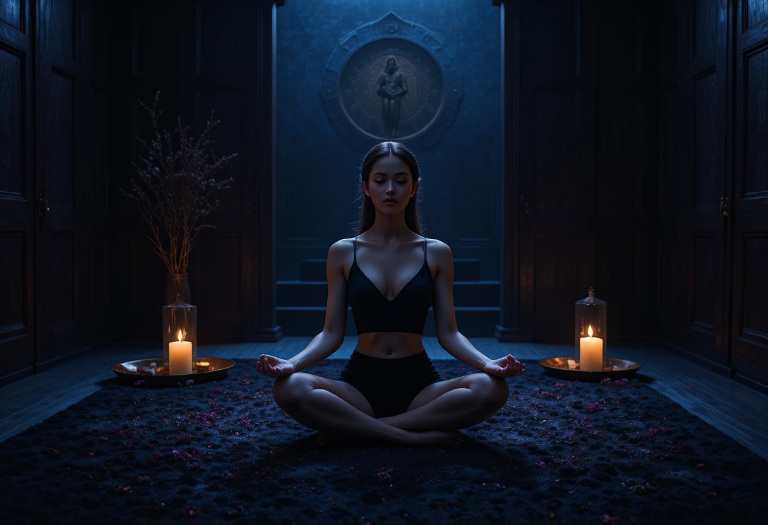
This is the one that sounds too simple. It is also the one that, if you actually do it, will change you more than any of the others. Not because it is the most dramatic practice on this list — it is the least dramatic. But because everything else here is, in some sense, preparation for or an elaboration of this: the ability to be still and open and genuinely attentive. Every tradition of wisdom on Earth — every one, without exception — has understood this. The Quakers built an entire spiritual practice out of it. Buddhist meditation is a structured form of it. Contemplative Christian prayer is it. The Indigenous practice of “sitting out” — spending time alone in nature without agenda — is it. What the traditions are all pointing to is the same thing.
Sit somewhere quiet. Not silent necessarily — the sounds of the world around you are welcome. But quiet in the sense of being away from screens, from demands, from the performance of being a person who is productively doing something. Don’t try to meditate in any formal sense. Don’t try to achieve an empty mind or a particular state. Don’t try to do anything at all. Just be there, in your body, in the room, in the moment — and listen. Listen to the sounds around you. Listen to the sounds inside you: your breath, your heartbeat if you can feel it, the subsurface hum of your own nervous system. Listen to the thoughts that rise up without being invited, and instead of engaging them, just notice them pass.
What happens in this space — not immediately, not always, but reliably over time — is that things become clearer. Answers to questions you’ve been agonising over surface quietly, fully formed, without fanfare. Feelings you’ve been avoiding become accessible and therefore workable. Intuitions that have been drowned out by noise make themselves known. Experienced practitioners call this “sitting in the presence” because what you become present to, in the silence, is something larger than your ordinary thinking mind — something that has access to more than your conscious attention does, and that will speak if you give it the conditions it needs.
The magical tradition understands what modern neuroscience is also beginning to document: the default mode network — the brain’s activity during rest and inward attention — is associated with insight, creativity, emotional processing, and the synthesis of experience into meaning. When you stop filling every moment with input, you give the deep mind room to do its work. In magical terms: when you are quiet enough, you can hear what the world and your own deeper self are trying to tell you. That capacity — to be still enough to hear — is not a passive ability. It is a skill, trained through practice, and it is the foundation upon which everything else in this craft is built.
The tools were never the magic. You were.