


There’s a moment in nature that stops you cold. You’re walking through the woods, or sitting on your porch at dusk, and you notice it — the birds have stopped singing. The frogs have gone quiet. Even the insects seem to be holding their breath. Most people brush it off, chalk it up to coincidence, and keep scrolling through their phones. But for thousands of years, across every culture on earth, people paid serious attention to that silence. They knew something was either coming or already there.
Our ancestors were tuned into the natural world in ways most of us have completely lost touch with. They didn’t have weather apps or seismic detectors — they had the animals. Birds, insects, wolves, horses, cattle — these creatures were living sensors, and people watched them the way we watch the news. When the animals went quiet all at once, it wasn’t random background noise to be ignored. It was a message. And depending on where you lived and what your spiritual tradition was, that message could mean very different things — a warning, a visitation, a shift in the energy of the world itself.
What makes this so fascinating is that the spiritual meaning of animal silence wasn’t invented by one culture or one religion. It shows up everywhere — in Native American traditions, in ancient Chinese philosophy, in Celtic folklore, in African spiritual practices, in the Bible. It even shows up in the instincts of modern people who have never read a single spiritual text in their lives. That gut feeling you get when the woods go dead quiet? That’s not superstition. That’s ancient wisdom your body still remembers, passed down through generations of people who survived by listening when the animals stopped talking.
The Spiritual Meaning of Animal Silence Across Ancient Cultures

Long before science could explain animal behavior, people were already cataloging what it meant when creatures went quiet. And the explanations they came up with weren’t primitive guesses — they were sophisticated spiritual frameworks built on centuries of observation.
In many Native American traditions, animals were considered direct messengers from the spirit world. When they went silent collectively, it was understood that a spirit was moving through the area — not necessarily a threatening one, but one powerful enough to hush every living thing in its path. Elders would pay attention to which animals fell quiet and where, because the details mattered. A sudden silence from birds near water meant something very different from a silence that crept in from the forest’s edge.
Ancient Chinese philosophy, particularly Taoism, saw animal silence as a signal that the natural flow of energy — what they called qi — had been disrupted or was about to shift dramatically. Animals lived closer to this invisible current than humans did, and their quieting was like a dial on a cosmic radio going to static. The spiritual meaning of animal silence in this context was less about danger and more about transition — the world was preparing to change its frequency.
Celtic peoples across Ireland, Scotland, and Wales had a deeply practical relationship with animal behavior as spiritual communication. Silence from birds, especially ravens and crows, was taken as a sign that the boundary between this world and the Otherworld had thinned. The Celts believed there were moments — certain nights, certain weather, certain crossroads in the year — when the veil between the living and the dead grew thin enough to pass through. When animals could sense that thinning, they fell quiet out of something that looked very much like reverence.
When Silence Meant a Spirit Was Near

One of the most widespread spiritual beliefs about animal silence is that it signals a spiritual presence — something unseen moving through the physical world. This isn’t a fringe idea held by a few isolated tribes. It’s essentially a universal belief, found on every inhabited continent.
The logic behind it is actually quite beautiful. Animals, in most spiritual traditions, exist in a kind of in-between state. They’re physical beings, yes — but they’re also deeply connected to the spiritual layer of reality in ways that human beings, with all our thinking and analyzing, have largely disconnected from. A dog can sense a spirit in a room before any person does. A horse can feel unease in a place that looks perfectly safe to human eyes. Birds stop singing when something that doesn’t belong to the visible world passes by.
In many West African spiritual traditions, animal silence was a direct indication that ancestors were visiting. Far from being scary, this was often welcomed. Silence was treated as a sacred pause — a moment to be still, to listen inward, and to receive whatever wisdom or warning the visiting spirit was carrying. Noise and distraction were considered ways of missing the message entirely.
In Christianity and Jewish mystical tradition, animals perceiving the divine shows up repeatedly. Balaam’s donkey saw the angel of the Lord before Balaam did. The animals in the stable at Bethlehem were present for a moment that changed history. There’s a consistent thread in these traditions that animals perceive the sacred more readily than humans, and their behavior — including their silence — reflects that perception.
Animal Silence as a Warning Sign

Not all spiritual interpretations of animal silence were peaceful. Many traditions read it as a warning — something dangerous, dark, or destructive was on its way.
This is where the spiritual meaning of animal silence overlaps most closely with what we now understand scientifically. Animals go quiet before earthquakes. They go quiet before storms. They go quiet before predators move through an area. For ancient people, there was no real separation between the physical danger and the spiritual dimension of that danger. A coming earthquake wasn’t just a geological event — it was a message from the earth itself, from the spirits that governed the land. The silence of the animals was how that message got delivered.
Indigenous peoples across South America treated mass animal silence — particularly when birds, insects, and larger animals all went quiet simultaneously — as one of the most serious warning signs possible. It meant the land was speaking urgently, and ignoring it was considered not just unwise but spiritually disrespectful. Communities had protocols for this. When the silence hit, people stopped what they were doing and paid attention.
In European folklore, nighttime silence from animals was particularly feared. The sudden hushing of frogs, crickets, and owls in the middle of the night was called by various names across different regions — some traditions called it the “dead hour,” others called it the “devil’s breath.” It was universally understood as a moment when dark forces were moving and human beings were most vulnerable. The appropriate response was to be still, to pray, and to wait for the animals to start up again — their return to noise being a signal that whatever had passed had moved on.
What Horses and Dogs Knew That We Didn’t
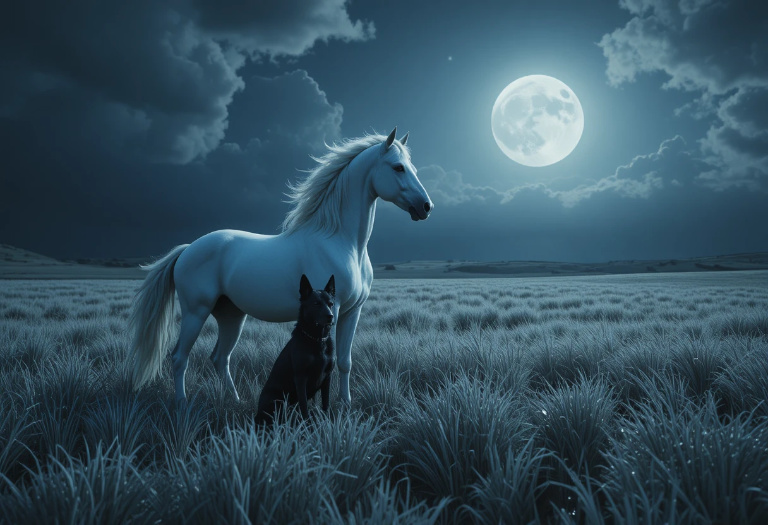
Certain animals were considered especially spiritually sensitive, and their silence carried extra weight. Horses and dogs show up again and again in world spiritual traditions as the most reliable animal signals.
Horses have been considered spiritually attuned in virtually every culture that kept them. In Norse tradition, Odin’s eight-legged horse Sleipnir could travel between worlds. In Celtic belief, white horses were psychopomps — guides for the dead. Across Asia and the Middle East, horses were believed to sense djinn, demons, and other spirits long before humans could. A horse that suddenly stops moving, raises its head, and goes absolutely silent — ears forward, nostrils wide, every muscle still — was considered to be perceiving something from the other side. Smart travelers stopped when their horse stopped. The spiritual meaning of a horse’s silence was considered one of the most trustworthy signs in the natural world.
Dogs were even more universally associated with the spirit world, possibly because of their long relationship with death — they were present at burials, they howled at things no one else could see, and in tradition after tradition they were portrayed as guardians of the threshold between life and death. In ancient Egypt, Anubis — the god of the dead — had the head of a dog. In Greek mythology, the three-headed Cerberus guarded the underworld. When a dog goes quiet and still, staring at something invisible in a room, almost every spiritual tradition on earth has an explanation for it — and that explanation involves something from the other side being present.
The Earthquake Connection and What Science Eventually Confirmed

Here’s where it gets really interesting — science eventually caught up with what spiritual traditions had been saying for thousands of years.
Animals do go quiet before earthquakes. This has now been documented enough times that researchers take it seriously as a field of study. The working theory involves animals sensing the ultra-low frequency sounds, electrical changes, and subtle ground vibrations that precede seismic activity — signals that human senses simply can’t detect. Before the devastating 2004 Indian Ocean tsunami, wildlife observers noted that elephants, flamingos, dogs, and other animals moved away from coastal areas hours before the wave hit. The animals knew. The silence came first, then the movement, then the disaster.
For ancient spiritual communities, this wasn’t a “science versus spirituality” moment — it was confirmation of what they already believed. The earth is alive. It communicates. The animals are the translators. Whether you call that communication a spiritual message or a biological response to electromagnetic fields, the practical outcome is the same: when the animals go quiet, pay attention.
What’s spiritually significant about this overlap is that it suggests the people who built these traditions weren’t just making up stories. They were careful, long-term observers of the world around them, and they encoded what they saw into spiritual frameworks because those were the frameworks available to them. The wisdom was real. The medium was mythology. Both can be true at the same time.
What to Do When You Notice the Silence
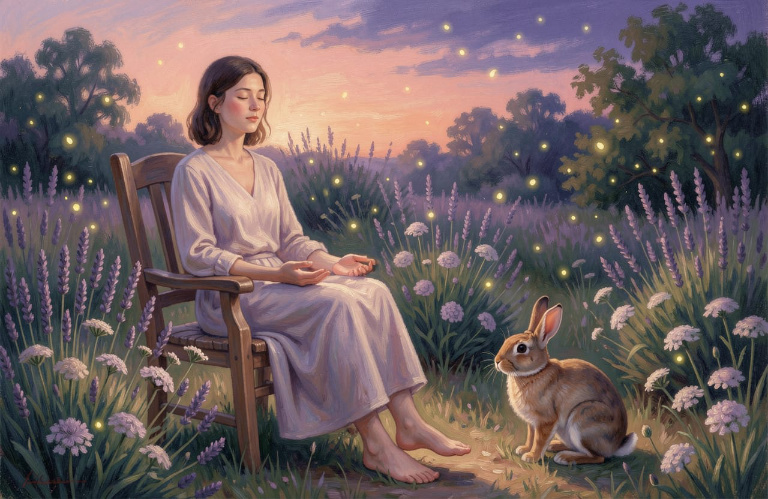
So what do you actually do with this? If you’re sitting outside one evening and everything goes quiet at once — the crickets, the birds, all of it — here’s how people across spiritual traditions have suggested responding.
The first and most consistent piece of advice across traditions is simply to stop and be still. Don’t fill the silence with your own noise — with talking, or scrolling, or moving around. The silence is an invitation to perceive something, and you can’t accept that invitation if you’re busy doing other things. Breathe slowly and let your own senses open up as wide as they’ll go.
The second is to pay attention to how the silence feels in your body. Fear and awe feel similar but distinct. If your body is on high alert — heart rate up, senses sharp, every instinct screaming to look around — that’s a warning signal, and your body is agreeing with the animals. If the silence feels heavy but calm, almost sacred, that’s a different message. Many traditions would say that’s a visitation, something coming through from the other side that means no harm.
The third is to watch what the animals do after the silence breaks. Do they resume normally, gradually coming back to their usual sounds? Or does something else happen — do they move together in a direction, do certain species call out before others, does the quiet return? The return to sound, and the quality of that return, was considered just as spiritually significant as the silence itself. The whole event was a conversation, not just a single word.