


There’s something they don’t tell you about witches who work alone. No dramatic coven initiation, no robes, no circle of hands — just you, the dark, and something ancient stirring in your chest. The solitary witch is one of the oldest archetypes in magical history, and right now, more people than ever are finding their way to this path not because they couldn’t find a group, but because they never needed one. Something inside them already knew the way.
Being a solitary witch isn’t a consolation prize. It’s not what you settle for when you can’t find your people. It’s a deliberate, deeply personal choice to do the work alone — to build a practice that belongs entirely to you, shaped by your intuition, your timing, your rules. The magic you make by yourself carries a signature that no one else can replicate, because it comes from the most honest version of you — the one nobody gets to see.
The world tends to picture witches in groups. It’s a powerful image — candles in a circle, voices rising together, shared intention cutting through the air. But that image leaves out the witch sitting alone at her window at 3am, notebook in hand, tracking the moon and talking to her dead grandmother. It leaves out the one who does their shadow work in the bathtub, or slips outside barefoot at midnight just to feel the ground. Those witches are just as real. Often, they’re the most powerful ones of all.
This is for them. For the ones who feel more at home in solitude than in ceremony. For the ones whose magic is a private language — spoken quietly, heard deeply, answered every time. Whether you’ve been practicing for years or you’re just now realizing that what you’ve always been doing is a practice — this is the map. Not a rule book. A map. The path is already yours.
The Quiet Power of the Lone Path

There is a specific kind of power that only develops in silence. When you strip away the group, the shared texts, the agreed-upon methods, what’s left is raw — just you and the work. Solitary witches don’t have the luxury of borrowed confidence. They can’t look sideways at someone else mid-ritual to check if they’re doing it right. That absence of external validation forces something profound: genuine trust in yourself. Over time, that trust becomes the most powerful tool in any witch’s arsenal, and it runs deeper than almost anything a coven can teach.
The lone path also demands a kind of honesty that group practice can sometimes soften. In a coven, you can coast on collective energy. You can show up halfway and still feel the current. Alone, the energy is all yours — which means your blocks are all yours too. Your resistance, your doubts, your half-hearted intentions — they all show up clearly when there’s no one else in the room. This sounds hard, and sometimes it is. But it’s also the fastest route to genuine growth. Solitary witchcraft holds up a mirror and doesn’t look away.
What surprises most solitary witches — especially those who worried the path might feel lonely — is how full it gets. The practice becomes deeply personal, almost conversational. The seasons start to feel like old friends. The moon becomes a relationship. The space between rituals becomes as meaningful as the rituals themselves. There’s an intimacy to working alone that group practice, for all its beauty, simply can’t replicate. When it’s just you and the craft, everything gets more interesting.
Signs You’re a Natural Solitary Witch

1. You’ve Always Had a Private Inner World No One Else Gets to See
From a young age, you had an inner life that felt bigger and stranger than anything happening around you. Maybe you kept journals no one was allowed to touch. Maybe you had rituals you did quietly — a specific way you greeted the moon, something you whispered before sleep, a stone you kept in your pocket for reasons you didn’t explain. This wasn’t shyness, exactly. It was protection. You knew instinctively that some things lose their power when exposed to the wrong eyes.
That private inner world is the original temple of the solitary witch. Everything you’ve built since then — every practice, every intuition, every strange knowing — grew out of that protected interior space. The solitary witch doesn’t hide because she’s ashamed. She keeps things sacred because she understands, on a bone-deep level, that not everything is meant to be shared. Privacy isn’t limitation. It’s preservation.
And the beautiful thing is, that inner world only gets richer the more you tend it. When you stop trying to explain your practice to people who won’t understand it, something relaxes. The magic gets stronger. The signs become clearer. It turns out the inner world was waiting for you to stop looking outward and finally, fully, come home.
2. Group Energy Often Exhausts You More Than It Fuels You
You’ve been to gatherings — maybe even magical ones — and come home feeling more drained than when you arrived. People love you, you love them, and yet something about being in a group just costs you. This isn’t a flaw. For the natural solitary witch, group energy can feel like static — too much signal, too much noise, not enough of the quiet frequency you need to actually feel anything. Your antennae are calibrated for subtlety, and crowds are rarely subtle.
This shows up in magical settings too. Shared rituals can feel performative, awkward, too loud. You find yourself going through the motions while the real work — the deep, felt, internal work — happens later, alone, when everyone’s gone home. That’s your practice telling you something. It’s not that you can’t appreciate group magic. It’s that your native frequency is different. You pick up more when the room is empty.
Solitary practice lets you work at your own energetic pace, which for many witches makes an enormous difference. No one else’s anxiety bleeding into your concentration. No one else’s grief hijacking the intention. Just your energy, shaped by your will, moving exactly where you direct it. For an empath or a highly sensitive person — which many solitary witches are — that kind of clean, quiet container isn’t a luxury. It’s a necessity.
3. You Observe the Natural World Like You’re Reading a Language
You notice things. The way the light changed before that difficult conversation. The crow that showed up three times in one week. The fact that you’ve been finding feathers every time a major decision is coming. Most people would call this coincidence and move on. You filed it away, cross-referenced it with the last time something similar happened, and started watching for the next piece. You are, without having been formally taught, already reading the world as a text.
This is one of the most natural and ancient witchcraft skills there is — augury, omen-reading, pattern recognition in the living world. And it’s a skill that flourishes in solitude. When you’re alone with nature, you stop performing and start listening. The wind says something different when no one’s talking over it. The moon communicates in a register that requires stillness to receive. Solitary witches tend to develop this sensitivity naturally, because they spend enough time in quiet to actually hear what’s being said.
Over time, this reading of the world becomes second nature — a continuous, ambient awareness of the signals moving through your environment. You start to trust it. You start to act on it. And here’s the extraordinary thing: it starts to answer back more clearly. The relationship between a solitary witch and the natural world deepens in direct proportion to the attention she gives it, and that’s a relationship that gets better every single year.
4. You Are Drawn to the Moon Without Really Knowing Why
It’s not symbolic for you — or if it is, it’s also something else. The moon pulls at something physical. You sleep differently depending on the phase. Your moods shift. Your creativity surges and contracts in a rhythm you eventually recognized as lunar. Maybe you started tracking it long before you’d have called it a magical practice. Maybe you just knew, intuitively, which nights were safe and which ones felt charged.
Moon sensitivity is one of the clearest signs of a natural solitary witch, partly because moon work is so fundamentally personal. The moon doesn’t need a group. Her relationship with you is individual, ongoing, and surprisingly responsive. Different people feel different phases most strongly — some come alive at the full moon, some do their deepest work in the dark of the new moon, some feel the pull of the waning crescent like a tide going out. Your moon is your moon.
The solitary witch who leans into moon communion usually finds that her practice organizes itself naturally around lunar time. Planning becomes lunar planning. Intentions become new moon intentions. Releases become full moon releases. It’s one of the most elegant natural calendars in existence, and it’s been tracking human cycles for longer than most traditions have been named. When you let the moon set the pace, something in your practice settles into a rhythm that feels less like habit and more like breathing.
5. You Process Everything Internally Before You Can Talk About It
When something big happens — a loss, a fight, a revelation — your instinct is to go quiet, not to reach for your phone. You need to sit with things before you can speak them. You go for long walks alone. You write. You stare out windows. This isn’t avoidance. It’s a deeply internal processing style that’s actually a core feature of the solitary witch temperament — and it maps almost perfectly onto the kind of introspective, shadow-facing work that solitary practice requires.
Shadow work — the practice of examining the parts of yourself you’d rather not look at — is one of the most powerful tools in the solitary witch’s kit, and it genuinely cannot be rushed or performed for an audience. The people who are naturally good at it are the ones who already know how to be alone with uncomfortable truths. If you’ve spent most of your life wrestling with your own depths before bringing anything to the surface, you’ve been in training for this without knowing it.
There’s a gift buried in this internal processing style, and it’s this: your self-knowledge runs unusually deep. You know your patterns. You know your triggers. You know the difference between intuition and anxiety, between a genuine sign and wishful thinking. That kind of self-awareness is the backbone of powerful magical work. It’s the reason solitary witches so often trust their own readings over anyone else’s — because they’ve done enough internal work to actually hear themselves clearly.
6. Your Home Is Your Sanctuary, and You Feel It
Not just comfortable — charged. You’ve arranged things just so, not always knowing why. Certain corners feel right. Certain objects belong and others don’t. You have places in your home where you go to think, and those places hold the quality of those thoughts over time. Visitors sometimes comment on the feeling of your space — calm, or electric, or somehow heavier in a way they can’t articulate. You smile and say thank you. You know exactly what that is.
The solitary witch’s home becomes her temple by accumulation. Every ritual held there, every intention set, every night of focused attention adds to the atmosphere. Unlike a shared space or a borrowed coven circle, a personal home temple is built slowly, privately, and entirely in alignment with one practitioner’s energy. Nothing is placed there to impress anyone. Everything has a reason, even if that reason is just felt.
This instinct to create sanctuary is one of the most telling signs. It means you understand, perhaps without language for it, that space holds energy — that the environment you inhabit affects what’s possible within it, and that it can be shaped deliberately. That understanding is foundational. Most people never think about it at all. Solitary witches spend their lives refining it.
7. You’ve Always Felt Like Magic Was Real — Even Before You Had Words for It
Not in a naive way. In a cellular way. The feeling that there is more to this than what you can see. That coincidences are not always accidental. That intention has weight. That some places are thinner than others, some times more charged than others, some people carrying something that can’t be explained by personality alone. You didn’t read this somewhere. You felt it before you had any framework to put it in.
This preverbal, pre-theoretical sense that magic is real is the hallmark of what many would call a natural witch — someone for whom the inclination isn’t learned but remembered. The study, the tools, the traditions — those come later. But the original knowing was already there. And for most solitary witches, that knowing was never something they could fully share with anyone else. It was simply always true, quietly and privately, in the background of everything else.
When you finally encounter a framework — a word, a tradition, a practice — that matches what you’ve always felt, there’s no conversion experience. There’s recognition. A kind of relief. Oh, so there’s a name for this. There are others. And I’ve apparently been doing it all along. That moment of recognition is one of the most common stories in solitary witchcraft, and it might be the most universal sign of all — not that you found magic, but that magic, one way or another, always found you.
Crafting a Private Ritual Space
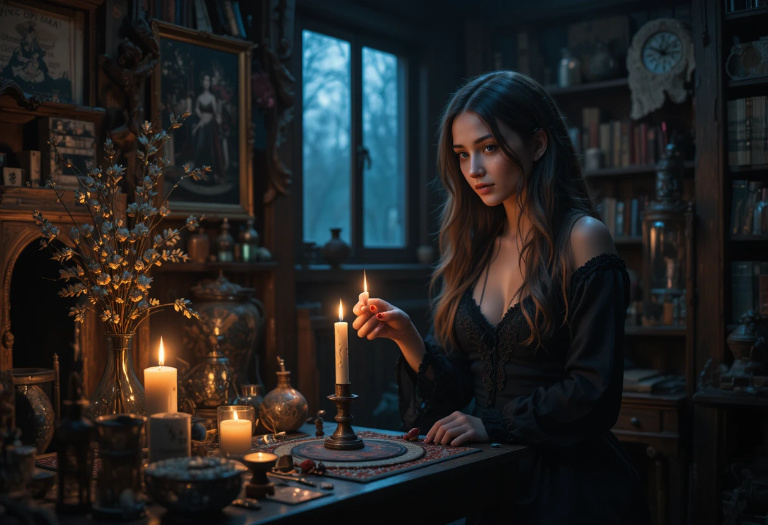
The solitary witch’s ritual space doesn’t need to be a dedicated room, a locked cabinet, or an elaborate altar — though it can be any of those things. What it needs to be is intentional. Even a single shelf, a windowsill, or a corner of a desk can hold an extraordinary amount of energy when it’s treated with consistency and care. The space doesn’t create the magic. You do. But the space holds it between workings, which over time turns even the humblest corner of a small apartment into something genuinely powerful.
Start with what you’re drawn to, not what looks right in photos. This is your private space — no one else needs to understand it or find it aesthetically correct. If you want bones and moss and a chipped teacup that belonged to someone you loved, that’s your altar. If you want clean lines and a single candle and nothing else, that’s your altar too. The objects that belong in a ritual space are the ones that feel alive when you touch them, not the ones that check off a list. Follow that feeling ruthlessly, and your space will build itself over time.
Think practically about privacy and maintenance. Your space should be somewhere you can return to regularly — not just for big rituals, but for small daily check-ins. Light a candle. Set an intention. Breathe. The more you use a space for intentional purpose, the more it holds. Cleanse it regularly, whether that means smoke, sound, salt, or simply opening a window and letting fresh air move through. And protect it — not everyone who enters your home needs access to the most concentrated point of your practice. Some things are simply not for everyone’s eyes, and that’s not secrecy. That’s wisdom.
Tools of the Lone Witch

The solitary witch doesn’t need a storefront’s worth of equipment to practice powerfully. What she needs are tools that feel like extensions of herself — objects that carry her energy well and respond to it cleanly. Because there’s no group pooling their collective tools and intentions, the solitary witch’s objects tend to become more deeply charged over time, handled often, specific to her particular way of working. Each one is a relationship, not a prop.
The most important criterion for any tool isn’t its price or its provenance — it’s whether it works for you. Some witches operate with almost nothing. Others build elaborate collections over decades. What matters is that every tool earns its place through use, through intention, through genuine resonance. Here’s what tends to show up most often on the lone witch’s table:
- A journal or Book of Shadows — Your primary record-keeping tool. Track observations, dreams, moon phases, rituals, results. Over time this becomes an irreplaceable personal grimoire specific to your path.
- Candles — Simple, direct, universally useful. Flame focuses intention and marks the beginning and end of sacred time. Even one candle changes the quality of a space.
- A blade or athame — Used for directing energy, casting circles, and cutting cords — not for cutting anything physical. Can be a simple kitchen knife if that’s what you have.
- A chalice or cup — Represents the water element, the emotional self, the receptive principle. Any cup you love can serve this purpose.
- Crystals and stones — Chosen by feel as much as by lore. Carry them, sleep with them, place them on your body during meditation. They hold and transmit energy reliably.
- Herbs and botanicals — For burning, bathing, spell bags, teas, and offerings. Even a few basics — rosemary, lavender, sage, mugwort — cover an enormous range of workings.
- A mirror — One of the most underrated solo tools. Used in scrying, in mirror magic, and in shadow work. The lone witch and the mirror have a long, profound history.
- A pendulum — A simple, effective divination tool that works particularly well in solitary practice because it responds to your personal energy field directly.
- Moon water — Made simply by leaving water under the full moon overnight. Endlessly versatile — for cleansing, charging, spell work, and anointing.
- A compass or knowledge of directions — For casting circles and working with elemental energies. You don’t need a fancy tool for this; orientation matters more than equipment.
Rituals That Thrive in Silence

Some magic genuinely needs an audience — group spells, community healing, shared celebration. But some magic becomes more potent the quieter and more private it is, and these are the practices that the solitary witch tends to excel at.
Shadow work is the practice of examining the parts of yourself you’ve hidden, suppressed, or disowned. It requires a level of honesty that most people only manage in complete privacy. Sit with a candle, a journal, and a prompt — What am I afraid people would see in me? What do I keep punishing myself for? What am I still carrying that was never mine? — and follow the thread wherever it goes. Shadow work done consistently is genuinely transformative, and it’s almost always a solitary endeavor.
Mirror magic has a long history in witchcraft precisely because mirrors are portals of self-confrontation. Used for scrying (gazing softly into the surface in low light until images or impressions arise), for affirmation work, or for sending intentions directly back into yourself, the mirror is a profoundly solitary tool. Look at yourself without looking away. Say what you mean. The mirror, unlike most audiences, doesn’t flinch.
Cord-cutting is a ritual for releasing attachments — to people, situations, patterns, versions of yourself you’ve outgrown. You need two cords (or strings, or ribbons), something to bind them together, and something to cut them with. Name what you’re tied to and why you’re releasing it. Cut the cord. Burn both pieces if you can. Do it alone, out loud, with full feeling. The emotion is part of the spell.
Moon communion is exactly what it sounds like — going outside at night under the moon, alone, and simply being present with her. No agenda required. Some nights you’ll receive a clear impression or answer. Other nights you’ll just feel held. Both outcomes are valuable, and both happen more readily when you’re not managing anyone else’s experience at the same time.
Energetic Boundaries & Psychic Defense

Working without a coven means you don’t have a group field to fall back on, and you very quickly learn to build your own. This is actually one of the great gifts of solitary practice — the witches who develop their own energetic defense tend to do it more thoroughly and more personally than those who’ve always relied on collective protection. Necessity is an excellent teacher.
Shielding is the foundation. Before you leave your house, before any significant social interaction, before you do any kind of reading or energetic work, you build a shield. There are countless methods — visualizing a wall of light, wrapping yourself in smoke, imagining mirrored surfaces that reflect back what doesn’t belong to you. The most effective shield is the one you practice regularly enough that it becomes automatic. Start with intentional daily practice and watch it become reflex.
Cleansing your space is equally non-negotiable. Smoke (incense, herbs, resins), sound (bells, singing bowls, clapping in corners), salt water, fresh air, candlelight — all of these move and clear stagnant or unwanted energy. The solitary witch learns to feel when her space needs clearing and responds accordingly, rather than waiting for a scheduled ceremony.
Warding the home means placing intentional protections in or around your living space — sigils drawn on doorframes, black tourmaline at thresholds, protective herbs above entrances, charged objects at windows. These are long-term guardians. Set them with clear intention, refresh them periodically, and trust them.
Grounding after workings is a simple but essential practice that prevents the disorientation and energetic bleed-through that comes from leaving a ritual incompletely. Eat something. Stand barefoot on earth if you can. Press your hands flat to the floor. Breathe down. Let excess energy drain back into the ground, where it can be composted into something useful. The earth handles this remarkably well.
Most importantly, trust your own read on what enters your space, physically or energetically. The solitary witch is often highly attuned to the energy of people and places, and that attunement is valuable data. If someone leaves your space feeling heavier, or if a location makes your skin prickle in a way you can’t explain, those signals are worth heeding. Your instincts are part of your defense system. Honor them.
The Art of Self-Initiation
There’s a myth in some magical circles that you can only be a real witch if someone else makes you one. That you need a lineage, a teacher, a ceremony performed by people who were already granted the authority to perform it. This idea has never held up under scrutiny, and if you feel called to the solitary path, it especially doesn’t apply to you. Self-initiation is not a lesser version of formal initiation. It is, in many ways, the more demanding one — because every bit of meaning in the ceremony comes entirely from you.
Self-initiation is the act of formally claiming your path. It’s the moment you stop treating your practice as something you’re trying out and name it as what it actually is: yours. The ceremony itself can be as simple or as elaborate as feels true. What it needs to contain is sincerity. A statement of intention — I commit to this path, to this work, to honest practice and continued growth. An acknowledgment of what you’re stepping into. An acknowledgment of who has walked it before you. And a threshold — some concrete marker that distinguishes the person who began the ritual from the one who ends it.
You don’t need anyone’s permission for this. Not a high priestess, not a tradition, not even the validation of a community that recognizes your work. The legitimacy of a magical path is determined by one thing: the honesty and consistency of the practice. If you show up, if you do the work, if you keep learning and keep moving — that’s a real practice. The ceremony of self-initiation is simply the moment you look that truth in the eye and shake its hand.
After that ceremony, something shifts — quietly but unmistakably. The practice feels different. More serious. More yours. Many solitary witches report that their magic becomes noticeably stronger following a self-initiation, not because the ceremony transferred power from somewhere external, but because the act of committing fully removed an internal reservation they hadn’t known was there. Power, it turns out, doesn’t flow well through ambivalence. Claim the path completely, and the path opens up.
When Solitude Becomes Power

There is a level of magical development that is simply not available to anyone who is always working in a group. It requires a specific kind of silence — not the silence of an empty room, but the silence of a practitioner who has spent enough time alone with their own energy that they know exactly where it starts and where it ends. That precision is extraordinary. It’s the difference between a general sense that magic is happening and an acute, reliable awareness of how, when, and why. It is, in the end, the difference between practicing magic and being it.
The solitary witch who stays the course accumulates a kind of authority that is difficult to articulate but impossible to miss. It’s not arrogance — it’s groundedness. It’s the particular quality of someone who has tested their own practice over years, alone, without anyone else’s confirmation that it was working, and kept going anyway. That kind of self-trust becomes its own form of power, and it radiates. People feel it. Spaces feel it. And the work — the actual magical work — reflects it in results that surprise even the practitioner.
Solitude, practiced with intention rather than just endured, becomes one of the most powerful states available to a human being. The great mystics knew this. The oracles knew it. The hedge witches and wise women who worked at the edges of villages knew it — they held power precisely because they stood slightly apart, with access to a territory that the ordinary social world didn’t reach. The solitary witch inherits that lineage directly. She doesn’t need a coven to be powerful. She has something rarer than that: herself, fully known, fully trusted, and fully committed to the work.