

There’s something in you that already knows the elements. Not from a textbook — from standing in a thunderstorm and feeling something wake up inside your chest, or sitting next to a fire and watching your thoughts slow down without trying. Water, fire, earth, air — these aren’t just things out there in the world. They’re languages. And somewhere along the way, most of us forgot we were fluent.
Every tradition that ever tried to make sense of existence — from ancient Greece to China, from the Celtic lands to the Amazon basin — landed on some version of the same idea: that reality is made of elemental forces, and that human beings are made of them too. This wasn’t poetry (well, it was also poetry). It was a working map of how life actually moves. Fire is transformation. Water is emotion and flow. Earth is stability and body. Air is thought and connection. When you understand that, ordinary days start to look very different.
The thing is, you’re already working with the elements whether you know it or not. You just might not be doing it consciously. You reach for warmth when you’re sad. You need to be near the ocean when life gets heavy. You garden when everything feels out of control. You open windows when your mind won’t stop spinning. These aren’t random habits — they’re instincts. You’ve been speaking elemental language your whole life. This is just about turning up the volume.
What follows isn’t a course or a complex system you have to master before anything counts. It’s a practical, living guide to weaving the elements into the texture of your everyday life — your mornings, your meals, your work, your relationships, your hard days and your good ones. You don’t need any special equipment or background. You just need to pay attention a little differently than you have been.
What the Elements Actually Are (And Why They Matter)

Before getting into the how, it helps to get honest about the what.
The four classical elements — earth, water, fire, and air — are best understood not as literal substances but as qualities of energy. Earth is anything dense, slow, stable, physical. Water is anything that flows, feels, shifts, connects. Fire is anything that transforms, ignites, consumes, illuminates. Air is anything that thinks, communicates, moves quickly, expands.
Many traditions also include a fifth element — spirit, ether, or akasha — the connective field that holds the other four together. Think of it as consciousness itself, or presence. We’ll touch on that too.
When these forces are in balance in your life, things work. When they’re not, you feel it — usually in your body first, then your mood, then your relationships, then everything else.
Working With Earth

Earth is the element of the body, the bones, the slow and patient and enduring. It governs stability, money, home, health, and anything that takes time to grow.
Signs you need more earth: You feel scattered, anxious, ungrounded, like you can’t finish anything. You’re living in your head. Your sleep is off. You feel disconnected from your body.
How to bring in earth energy:
Walk barefoot on actual ground when you can — grass, sand, soil. It sounds simple because it is. The body knows what to do when it gets that contact. Even five minutes resets something.
Eat root vegetables. Cook actual meals. Sit down to eat them. Earth energy lives in slow food, in the ritual of feeding yourself well.
Clean and organise your physical space. Clutter is energetically loud in a very earthy way — it fragments attention and makes the nervous system work harder. Tidying isn’t just tidying.
Work with your hands. Gardening, kneading bread, sculpting, woodworking — anything that puts your hands in contact with physical material and asks you to be patient with time.
Crystals and stones are earth element in concentrated form. Hold them, carry them, put them on your desk. Black tourmaline, obsidian, hematite, smoky quartz — these are grounding without being fancy.
The earth element asks you to slow down and take yourself seriously as a physical being with needs. Rest when you need to rest. Eat when you’re hungry. This is not laziness — it’s elemental alignment.
Working With Water

Water is the element of emotion, intuition, memory, and the unconscious. It governs relationships, dreams, healing, and anything that moves by feeling rather than logic.
Signs you need more water: You feel emotionally numb, dried out, unable to cry even when you want to. You’ve been pushing through on willpower and ignoring how you actually feel. Your creative well feels empty.
Signs you have too much water: You’re overwhelmed by feeling, crying easily, absorbing everyone else’s energy, struggling to maintain any kind of boundary.
How to work with water energy:
Spend time near it. A river, the ocean, a lake, a fountain, even a long shower or bath. Let it do what it does — it pulls something out of you that words can’t reach.
Track your dreams. Water rules the unconscious, and the unconscious speaks most clearly at night. Keep a notebook by your bed and write down whatever you remember, even fragments. Over time, patterns emerge.
Let yourself feel what you feel. Water element work is often just about stopping the bypass — the habit of intellectualising emotions instead of letting them move through. Feeling something fully for two minutes is worth more than avoiding it for two years.
Work with the moon. The moon and water are deeply linked — tides, cycles, the pull of something larger than logic. Notice how you feel at the new moon versus the full moon. Notice the rhythm. You have one too.
Drink more water, literally. Most people are mildly dehydrated most of the time and don’t connect it to their mood, their clarity, or the flatness they feel.
Water element practices teach you to trust what you feel and move with life rather than against it.
Working With Fire

Fire is the element of transformation, passion, will, creativity, and courage. It governs energy levels, motivation, personal power, and the ability to actually change things rather than just think about changing them.
Signs you need more fire: You feel flat, unmotivated, cold in spirit even if not in body. Projects stall. You know what you want but can’t seem to light up about it. Everything feels grey.
How to bring in fire energy:
Light actual fire. A candle on your desk, a fireplace, a bonfire if you can. Fire has an attention quality — it asks you to be present with it, and that presence transfers.
Move your body until you generate heat. Exercise is fire element in action. The aliveness that comes after a run or a dance or a workout isn’t just endorphins — it’s the fire element doing its work on you.
Do the thing you’ve been putting off. Fire isn’t just energy — it’s the willingness to act. Often the fire comes after you begin, not before. Start anyway.
Cook with actual heat, especially spicy food. Honour the transformation that happens when raw ingredients meet flame and become something completely different. That’s fire’s essential nature.
Write, make, create. Fire is creative force. Sitting down and making something — anything — feeds it. The critical voice that says it’s not good enough is water-air combination anxiety; the fire doesn’t care. It just wants to burn.
Spend time in the sun. Morning light especially carries fire element energy that sets your whole day’s rhythm in motion.
Fire teaches you that you have more power and vitality than you’re currently using. The question is always what you’re willing to transform.
Working With Air

Air is the element of mind, communication, ideas, movement, and connection. It governs how you think, how you speak, how you learn, and how you relate to others through language and story.
Signs you need more air: Your thinking is sluggish, stuck, repetitive. You feel isolated, uncommunicative, like you can’t find the words. Life feels heavy and immovable.
Signs you have too much air: Your mind won’t stop. You’re overthinking everything, starting things without finishing them, anxious without a clear reason, untethered.
How to work with air energy:
Open the windows. Let actual air move through your space. This is not metaphor — stale air affects the brain and mood in measurable ways, and fresh air shifts your state fast.
Breathe consciously. The breath is the most immediate air element practice available to you. A slow exhale activates the parasympathetic nervous system. Box breathing (in for 4, hold for 4, out for 4, hold for 4) clears a scattered mind in minutes.
Write. Journaling takes the swirling air of thought and gives it form on a page, which paradoxically calms the mental weather. Morning pages, stream of consciousness, letters you never send — all of it works.
Have conversations that actually matter. Air element energy moves through genuine exchange — not small talk, but real dialogue where ideas meet and something new is created between people.
Spend time with birds, wind, clouds, and high places. These are air element in its natural form and they recalibrate something in you just through proximity.
Read things that challenge you gently. New ideas are oxygen to the air element. Not argument, not debate for its own sake — but genuine exposure to ways of thinking you haven’t considered before.
Air teaches you that the mind is a tool, not a tyrant, and that words have power worth being careful with.
Putting It Together: A Simple Daily Practice
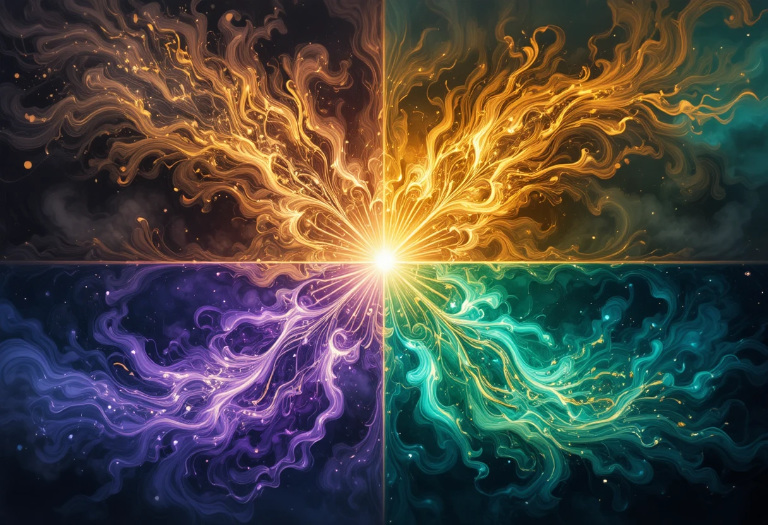
You don’t need to work with all four elements every day. What’s more useful is noticing which one you’re low on — or flooded with — and responding to that.
A simple version looks like this:
In the morning, check in. Body tight and anxious? Earth work. Emotionally raw or numb? Water work. Flat and unmotivated? Fire work. Mind spinning already? Air work.
Pick one practice. Just one. Do it with intention rather than going through the motions.
At night, notice what shifted.
Over time, you develop a feel for the elements the way you develop a feel for weather. You start reading your own inner climate and knowing what it needs. That’s the practice. That’s also, in a very real sense, the magic.
The Element You Keep Avoiding

One more thing worth saying: most people have one element they chronically avoid. An earth-avoider who lives entirely in the mind. A fire-avoider who won’t commit to anything in case it fails. A water-avoider who turns every emotion into a problem to be solved. An air-avoider who goes quiet when they need to speak.
The element that makes you most uncomfortable is usually the one doing the most work on you right now.
Lean toward it, not away. That’s where your growth is living.