


There’s something that happens when you put pen to paper with intention. It’s not just writing — it’s an act of magic in itself. A witchcraft journal is one of the oldest tools a practitioner can have, and for good reason. It holds your spells, your questions, your moon phases, your dreams, your failures, your breakthroughs. It becomes a living record of your path, and over time, it starts to feel less like a notebook and more like a companion.
You don’t need to be an experienced witch to start one. You don’t need a fancy grimoire with gold-edged pages or a leather-bound book that costs a fortune. You just need something to write in, something to write with, and the willingness to show up honestly on the page. That’s the whole secret, really. Your journal doesn’t care if you’re a beginner. It just wants the truth of where you are right now.
A lot of people hesitate because they think they’ll do it wrong. They worry their entries won’t be “witchy enough,” or that they don’t know enough yet to be writing things down. But that’s exactly backwards. You start the journal because you don’t know everything yet. It’s where you figure things out. It’s where you track what works, what doesn’t, what you felt during a ritual, what the candle did, what the dream meant. It’s your evidence, your memory, and your mirror.
This guide is going to walk you through everything — choosing your journal, setting it up, what to actually write inside it, and how to keep the habit going without burning out. Whether you’re drawn to kitchen witchcraft, lunar magic, herbalism, divination, or you’re still figuring out what calls to you, the journal is where it all comes together. Let’s get into it.
What Is a Witchcraft Journal

A witchcraft journal is exactly what it sounds like — a personal record of your magical practice. Some people call it a Book of Shadows, some call it a Grimoire, and some just call it their journal. The names carry slightly different meanings depending on who you ask, but the core idea is the same: it’s a dedicated space where your practice lives on paper.
The difference between a Book of Shadows and a Grimoire is worth knowing. A Grimoire is traditionally a reference book — spells, correspondences, herb properties, moon meanings. Think of it like a magical encyclopedia you build over time. A Book of Shadows is more personal. It holds your rituals, your reflections, your results, your feelings. Many witches keep both. But when you’re starting out, one journal that does everything is completely fine.
Why do you need one? Because magic without record-keeping is like cooking without ever writing down what you put in the pot. You might make something incredible and never be able to recreate it. You might notice that every spell you do on a waning moon falls flat — but only if you wrote it down and looked back. The journal turns your practice from a collection of random moments into a real, evolving system.
Choosing Your Witchcraft Journal
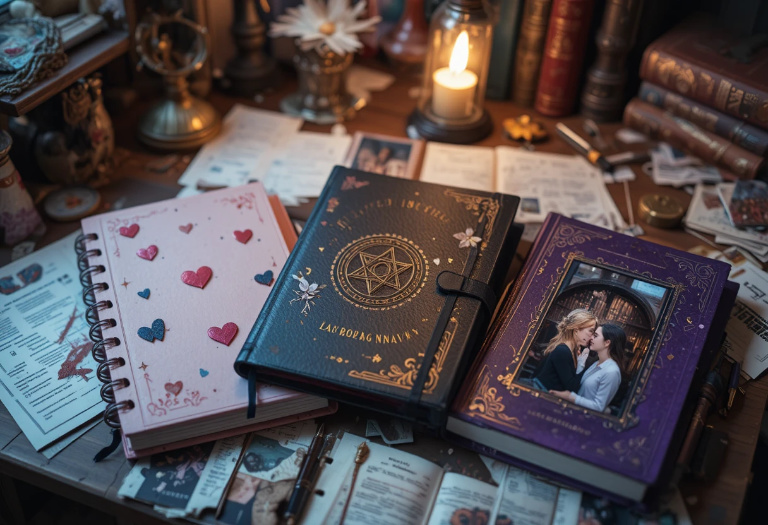
This part matters more than people think — not because there’s a right answer, but because you want something you’ll actually want to use.
Go with what calls to you. Some witches love a thick, cloth-bound journal with unlined pages. Others prefer a simple spiral notebook because it lays flat. Some use a ring binder so they can add, remove, and reorganize pages. Some go fully digital with an app or a private blog. All of these work. The best journal is the one you’ll actually write in.
A few things to consider:
- Size — Do you want something small enough to take everywhere, or a large one that lives on your altar?
- Lined, dotted, or blank — Lined is easiest for writing, dotted is great for both writing and drawing, blank gives total freedom
- How it feels in your hands — This sounds small but it isn’t. You’ll be holding this thing during sacred moments. It should feel right.
You can also do a simple consecration ritual when you get your journal — hold it, breathe into it, set an intention for what it will hold. That single act shifts it from a notebook to something more.
How to Set Up Your Witchcraft Journal

Before you dive into entries, it helps to set up a few foundational sections. Think of this like setting up a kitchen before you cook — you don’t have to do it perfectly, but having things in order makes everything easier.
1. An Introduction Page Write a little about yourself and where you are right now in your practice. Date it. This page will mean so much to you in a year.
2. Your Intentions What do you want from your practice? What are you seeking — healing, knowledge, connection, power, peace? Write it down. This becomes your compass.
3. A Table of Contents (optional but useful) If you’re using a bound journal, leaving the first few pages blank for a table of contents means you can actually find things later.
4. Reference Sections As you learn things, start building out reference pages: moon phases and what they mean to you, herbs and their properties, colors and their correspondences, symbols you work with. These sections grow slowly over time and become incredibly useful.
5. Your Ritual and Spell Records This is where the real magic gets documented. More on this below.
What to Write in Your Witchcraft Journal

This is where people get stuck, so let’s be specific. Here are the core things worth recording — you don’t need to do all of them every time, but knowing your options helps.
Spell and Ritual Records Every time you do a spell or ritual, write it down. Include the date, moon phase, your intention, what you used (candles, herbs, crystals, sigils), what you did, and how you felt during and after. Then — and this is the part most people skip — come back later and record what happened. Did it work? Partially? Not at all? What do you think made the difference?
Moon Phase Tracking The moon is one of the most reliable tools in witchcraft, and your journal is the perfect place to track it. Note the current phase, what energy it carries for you, and what intentions or releases you’re working with. Over time, you’ll start to see patterns in how you feel and how your magic lands at different points in the lunar cycle.
Dream Records Dreams are one of the ways magic speaks. Keep your journal near your bed and write down anything you remember as soon as you wake up — images, feelings, symbols, even if they don’t make sense yet. Patterns emerge over time that are genuinely startling.
Divination Readings If you use tarot, oracle cards, runes, pendulum, or any other divination tool, record your readings. Write the question you asked, what came up, and your interpretation at the time. Then note what actually unfolded. This is how you develop real skill with divination — not by memorizing meanings from a book, but by tracking your own intuitive hits.
Observations from Nature What season are you in? What animals are showing up around you? What’s blooming or dying? Witchcraft is deeply connected to the natural world, and noticing it — really noticing it — sharpens your awareness in ways that feed directly back into your magic.
Personal Reflections Don’t underestimate this one. Writing about what you’re going through emotionally and spiritually, what’s challenging you, what’s shifting — this is magic too. It’s the work underneath the work.
How to Keep the Habit Going

The most beautiful journal in the world does nothing if it sits closed on a shelf. Here’s how to actually make journaling a consistent part of your practice.
Take the pressure off. You do not need to write every single day. Even once a week is enough to build a meaningful record. Set a rhythm that fits your actual life, not an ideal version of it.
Keep it visible. Put your journal somewhere you’ll see it — on your altar, your nightstand, your desk. Out of sight really does mean out of mind.
Use prompts when you’re stuck. Some days you don’t know what to write. That’s fine. Have a few go-to prompts ready: What have I been noticing lately? What did my last dream feel like? What do I want more of right now? What spell have I been thinking about?
Let it be imperfect. Crossed-out words, messy entries, blank pages followed by long ones — all of that is normal and real. Don’t let perfectionism shut the whole thing down.
Revisit old entries. This is honestly one of the most magical parts. Going back to something you wrote six months ago and seeing how much has shifted — how something you asked for arrived, how something you feared passed — is genuinely moving. Schedule a monthly or seasonal review into your practice.
A Few Final Things Worth Knowing

Your journal is private unless you choose to share it. You don’t owe anyone access to it. You can lock it, hide it, ward it with a sigil on the cover — whatever makes it feel safe.
It will evolve. The journal you keep this year will look completely different from the one you keep in three years. That’s not failure. That’s growth made visible.
And finally — the act of writing things down is itself a magical act. Intention given form. Thought made real. Every time you open your journal and put something true on the page, you are practicing. You are already doing it.