
There’s a version of a witch that lives in movies and Halloween decorations — the pointy hat, the green skin, the cackle echoing through a stormy night. But real witches? They’re your neighbor who always has the most beautiful garden. They’re the coworker who seems to know exactly what you need to hear on a hard day. They’re the person at the farmers market who lingers a little too long over the herbs. They look like everyone else, because in most ways, they are everyone else. The difference is just that they’re paying closer attention.
Witchcraft, at its heart, is about relationship — with nature, with energy, with the quiet rhythms that most people have learned to tune out. A witch doesn’t need a dramatic ritual space or a cauldron bubbling in the corner (though some do love a good cauldron). More often than not, the magic is already threaded into the ordinary stuff of daily life. It’s in the way a morning cup of tea becomes a moment of intention. It’s in the instinct to crack a window open during a full moon. It’s in the strange pull toward a certain stone sitting in a shop window that you absolutely did not need but also absolutely could not leave without.
What makes witchy people interesting isn’t how different they are from everyone else — it’s how deeply they’ve leaned into the things most of us rush past. The smell of rain on hot pavement. The way candlelight changes the feeling of a room. The particular magic of a really good thrift store find. These aren’t exotic practices. They’re just ordinary life, held with a little more reverence. And once you know what to look for, you’ll start seeing it everywhere.
So here are thirteen things that witches tend to love in their everyday lives — the small, real, often completely unglamorous things that make up a magical existence. Some of these might surprise you. A few might make you realize that you, too, have been doing witchcraft this whole time without knowing it. And honestly? That tracks. Magic has always been hiding in plain sight.
1. The Smell of Rain
There’s a word for it — petrichor — that fancy scientific name for the smell of rain hitting dry earth. Most people think it’s nice. Witches think it’s everything. That scent isn’t just pleasant background weather; it’s the smell of the earth waking up, of water meeting stone, of the sky doing something ancient and enormous. For someone who works with natural energy on a regular basis, that moment when the first drops hit the pavement feels less like weather and more like a signal.
Rain has always carried deep spiritual weight across cultures and traditions. It cleanses. It renews. It breaks droughts, both literal and metaphorical. For witches, a good rainstorm can feel like a reset button on the world — like the air afterward is genuinely different, lighter, emptier of whatever had been sitting heavy in it. Many will take that moment to open their windows wide, let the rain-cooled air move through the house, and consider it a kind of free, effortless cleansing ritual that the sky is doing on their behalf.
There’s also something about the unpredictability of rain that feels magical. You can check the forecast all you want, but rain has its own agenda. Witches, who tend to spend a lot of time thinking about the forces larger than themselves, have a natural respect for things that can’t be fully controlled or predicted. Rain is a reminder that the world is alive and doing its own thing, and that we’re small and lucky to be in it.
Some witches collect rainwater — particularly water that falls during specific moon phases or storms — and use it in everything from watering magical herbs to adding it to floor washes or ritual baths. But honestly, even the ones who don’t do any of that still stop whatever they’re doing when it starts to rain, walk to the window, and just… breathe it in. That’s not a practice. That’s just love.
2. Thrift Stores and Antique Shops

Walk into any good thrift store with a witch and you will be there for a while. This is not a warning — it’s just the truth. These places are, to the witchy mind, absolutely overflowing with potential. Old things carry energy. Objects absorb the lives that have moved around them. A brass candlestick that sat on someone’s grandmother’s mantle for forty years isn’t just a candlestick. It’s forty years of dinners, arguments, celebrations, quiet evenings — all soaked in.
For witches who work with objects and their energies, secondhand shops are like treasure maps. The right cast iron pot for kitchen magic. A set of mismatched teacups that feel inexplicably right. A book on herbalism with someone else’s notes in the margins — which is somehow even better than a clean copy. There’s an intuitive quality to the way many witches shop in these spaces, wandering slowly, picking things up, waiting to feel whether something wants to come home with them. It sounds woo, and it kind of is, but anyone who’s ever walked past something in a thrift store only to turn around and go back for it knows exactly what that pull feels like.
There’s also an undeniable sustainability angle here that sits well with most witches’ values. Witchcraft, especially folk and earth-based traditions, tends to come with a deep respect for the material world — which means not adding to waste unnecessarily. Buying secondhand, reusing, repurposing — these aren’t just eco-friendly choices, they’re philosophically consistent with the idea that everything has value and nothing should be thrown away before its time.
The best thrift store days are the ones where you go in looking for nothing in particular and leave with something that feels like it was waiting specifically for you. Witches call that being called to something. Non-witches call it a lucky find. The result is the same: you go home a little richer and a little more delighted than when you left.
3. Candles — Always More Candles
Ask a witch how many candles they own and watch them get a little evasive. The honest answer is probably somewhere between “more than necessary” and “genuinely a fire hazard.” Candles are one of those things that start as a practical magical tool and gradually colonize every surface of a home before anyone quite realizes what happened. The windowsill. The bathroom. The kitchen counter. The little shelf above the desk. All of them, candles.
The reason candles are so central to everyday witchy life isn’t just ritual — it’s the quality of light itself. Candlelight changes a room. It softens everything. It moves, flickers, breathes in a way that electric light just doesn’t. For people who are sensitive to energy and atmosphere, the difference between a room lit by overhead fluorescents and one lit by three candles on the coffee table is almost physical. It’s not ambiance, exactly. It’s more like the room is suddenly more itself.
In magical practice, candles carry enormous meaning. The color matters. The way it burns matters — is the flame tall and steady, or small and flickering, or splitting into two? Witches read their candles the way some people read tea leaves, paying attention to what the fire is doing and what it might be communicating. A candle flame that leans consistently toward a window, or that goes out suddenly in a still room, or that burns for hours without dripping — all of these are noticed, logged, considered. Candle magic is one of the oldest and most accessible forms of spell work, and the fact that it’s also just lovely doesn’t hurt.
Even on days when there’s no spell in progress and no ritual planned, a witch will light a candle simply because the evening calls for it. Because the right light makes everything feel more intentional. Because flame is alive, and having something alive and warm in the room matters. It’s one of those witchy habits that anyone could adopt, and life would genuinely be better for it.
4. That One Weird Herb They’re Always Burning

Smoke cleansing — the practice of burning herbs to clear energy in a space — is one of those things that has crossed over into mainstream home décor culture in a big way. You can buy white sage bundles at Urban Outfitters now. But for witches, this is an ancient and genuinely meaningful daily practice, not an aesthetic. And most of them have opinions about which herbs they prefer, how they like to do it, and exactly what each plant is supposed to be doing.
The most common herbs used for smoke cleansing include white sage, rosemary, lavender, mugwort, cedar, and palo santo, among many others. Each carries its own traditional associations and properties. Rosemary is protective and clarifying. Lavender is calming. Mugwort is used for dream work and divination. A witch building a daily or weekly smoke cleansing practice will often choose their herb based on what they’re trying to shift in their space — clearing out lingering tension after a difficult week, inviting calm before bed, sharpening focus at the start of a workday.
There’s a sensory quality to it, too, that goes beyond the metaphysical. The smell of burning rosemary is singular and grounding. The smell of cedar is deep and earthy and old. These aren’t just pleasant fragrances — they trigger memory and instinct in a very real way. Smell is the sense most directly connected to the brain’s limbic system, which governs emotion and memory. Witches figured this out empirically long before neuroscience had language for it. Scent is a shortcut to a particular state of mind, and the right smoke can shift the feeling of a room in minutes.
The ritual of smoke cleansing also requires you to slow down and move through your space with intention — lighting the herb, watching it catch, walking room to room, paying attention to corners and windows and anywhere energy might sit still. It turns the ordinary act of being home into something more deliberate. Which is, in many ways, the whole point.
5. Moon Watching
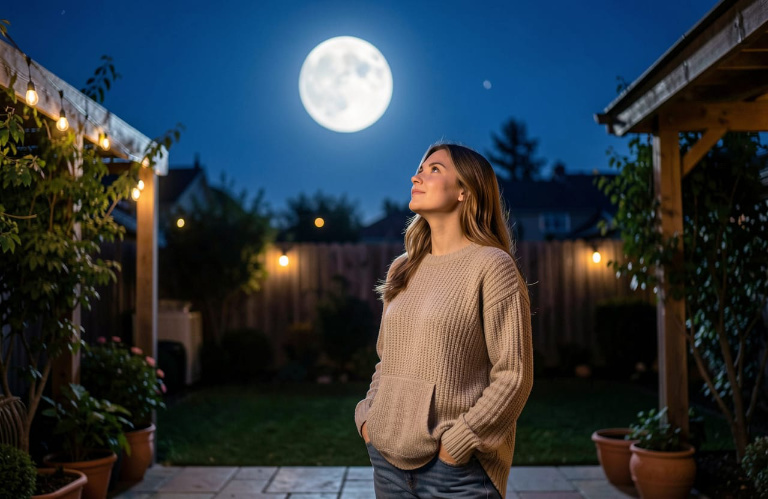
If you’ve ever noticed that someone in your life seems unusually aware of what the moon is doing at any given time, there’s a solid chance they’re at least a little witchy. Moon awareness is one of those tells. Most people know the full moon exists in a vague way. Witches know where the moon is tonight, what phase it’s entering, what sign it’s moving through, and what that probably means for the next two weeks.
The moon’s cycle — roughly 29.5 days from new to full and back again — is one of the oldest calendars in human history. Long before we had paper planners or digital calendars, people organized their lives around the lunar cycle. Planting, harvesting, fishing, traveling — all of it was timed to the moon. Witches, particularly those working in earth-based traditions, have retained this relationship. The new moon is for planting intentions and beginning new things. The waxing moon is for growth and building. The full moon is the peak — for completion, for power, for things coming to fruition. The waning moon is for releasing and clearing out. And then the cycle begins again.
But beyond the scheduling of spells and rituals, many witches just love the moon the way you love a very old, very dependable friend. Full moon nights have a particular quality to them — the light is different, the air feels different, and something in the human nervous system seems to respond whether we want it to or not. Witches don’t suppress that response or explain it away. They walk outside, look up, and let themselves feel it.
Some witches leave crystals on their windowsills or outside on the full moon to charge them in the light. Some make moon water by leaving a jar out overnight. Some just sit by the window with a cup of something warm and watch. All of these count. The relationship with the moon is one of the most consistent threads running through witchcraft traditions across cultures, and it’s also one of the most quietly joyful parts of everyday witchy life.
6. Really Good Tea

Tea and witches are such a natural pairing that it’s almost a cliché, except that it’s a cliché because it’s genuinely true. There’s a whole world of intention that can be folded into the act of making and drinking tea, and witches, who tend to find meaning in small daily rituals, have fully colonized this particular territory.
It starts with the herbs. Many witches grow at least some of their own herbs — on a windowsill, in a garden, in pots on a balcony — and the herbs they grow aren’t random. Chamomile for calm. Peppermint for clarity and energy. Lemon balm for mood and stress. Lavender for sleep. Rosehips for health. Making tea from these herbs isn’t just pleasant; it feels like an act of collaboration with the plant itself. You grew it, you dried it, you brewed it, you’re taking it into your body. That’s a whole relationship.
Tea can also be a form of simple kitchen magic. Choosing specific herbs for what you want to call into your day, stirring clockwise to bring things in or counterclockwise to push things away, setting an intention as the water steeps — none of this requires a big ritual setup. It’s just a cup of tea, held with awareness. Kitchen witchery, which is one of the most accessible and ancient forms of magical practice, is largely built on exactly this kind of small, daily intention.
And then there’s tasseography — reading tea leaves. It’s old and it’s wonderful and it requires absolutely no special tools beyond a loose-leaf tea and a cup. After the tea is drunk, the leaves that remain at the bottom form patterns and shapes that can be interpreted symbolically. Not every witch does this regularly, but most have at least tried it. Because drinking your tea and then getting to peer into your cup looking for symbols? That’s a pretty good morning.
7. Books — Especially Old, Weird Ones
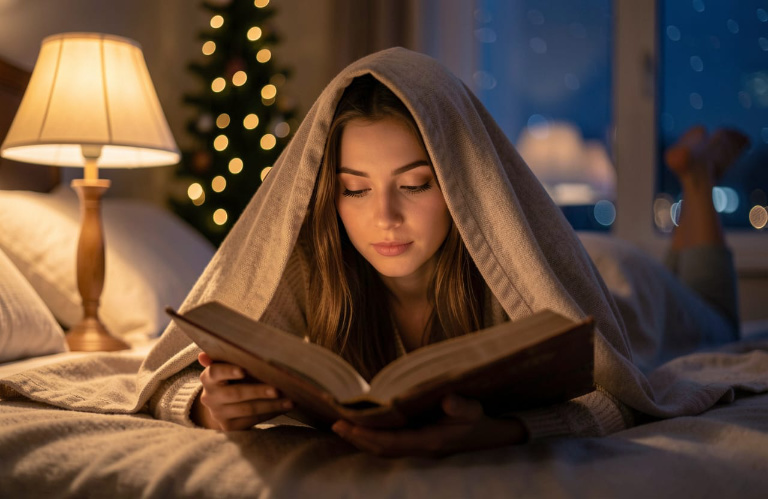
Walk into a witch’s home and you will almost certainly find books. A lot of books. Books stacked on shelves in no obvious order. Books on bedside tables. Books on the kitchen counter. A specific pile of books that hasn’t moved in months but is clearly meant to be there. And somewhere in the mix, almost always: at least one book that looks like it was found under unusual circumstances and should probably be examined more carefully before being touched.
The witchcraft tradition has a deep relationship with the written word. Grimoires — personal books of magical practice, spells, correspondences, and observations — are central to many traditions. Writing things down, keeping records, passing knowledge forward: these are acts of preservation and power. Many witches keep their own journals or books of shadows, handwritten records of their practice that accumulate over years into genuinely remarkable personal documents. The attachment to books as objects, as knowledge vessels, runs deep.
But it’s not just magical texts. Witches tend to be voracious and eclectic readers across the board — mythology, botany, folklore, history, psychology, anthropology, philosophy. The common thread is usually that they’re drawn to books that illuminate the hidden structures of things: how plants work, what people used to believe, why stories repeat across cultures, what the old words meant before translation smoothed them out. A book on Victorian mourning customs or medieval herb lore or the mythology of a culture they’ve never studied before is deeply exciting to most witches.
Old bookshops are almost as irresistible as thrift stores, for similar reasons. Old books have been held and read and thought about by real people over real years, and that history is palpable. A witch who finds a botanical manual from 1890 with pressed flowers between the pages has found something that is, to them, legitimately extraordinary. The book chose them, obviously. That’s just how it works.
8. Storms

If a witch goes quiet during a thunderstorm, they’re not scared. They’re listening. Storms are probably the most dramatic version of the natural world showing its hand, and for people who are paying close attention to the energy of their environment at all times, a proper storm is genuinely electrifying. Sometimes literally.
Lightning has been sacred in cultures across the world — associated with gods, with power, with the kind of energy that splits trees and reshapes landscapes in seconds. Thunder isn’t just noise; it’s the sky asserting itself. And the particular stillness before a storm, when the birds go quiet and the air gets that specific weight to it, is something that witches notice and most other people describe as “weird weather.” That pre-storm pressure is real, measurable, physical — but also deeply atmospheric in a way that goes beyond barometric readings.
Many witches work with storm energy deliberately. The rain from a storm can be collected for particularly potent water. The charge in the air — that static electricity feeling before lightning — can be directed, consciously or instinctively, toward whatever you’re working on. Storm magic tends to be fast and intense, which is why it’s often used for urgent intentions or for clearing things out dramatically rather than gradually. If the new moon is a quiet whisper of intention, a thunderstorm is a shout.
But mostly, witches love storms the way most people love their favorite music turned up very loud. It’s the world being big and unruly and absolutely unconcerned with your schedule, and there’s something both humbling and exhilarating about that. Standing at a window watching a storm roll in, or sitting on a covered porch while rain hammers down: this is not wasted time. This is communion.
9. Crystals and Stones
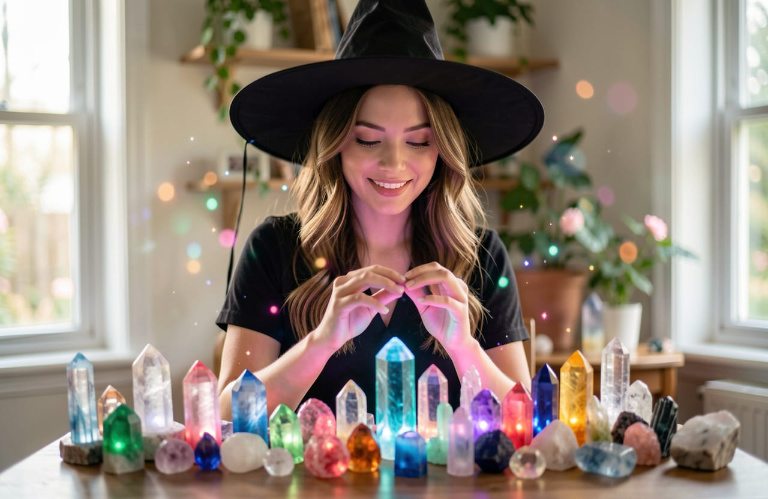
The crystal craze has hit the mainstream pretty hard in recent years, which means witches now have to navigate crystal shops full of people who are mostly interested in aesthetics and people who believe specific rocks will fix their anxiety. The truth, as most experienced practitioners will tell you, sits somewhere in the middle: crystals are real tools with real energy, and also they’re beautiful, and both things can be true.
Stones and crystals have been used in magical practice across cultures for thousands of years. Different stones carry different traditional associations — black tourmaline for protection, rose quartz for love and self-compassion, amethyst for clarity and spiritual connection, obsidian for grounding and truth, citrine for abundance and energy. These associations aren’t arbitrary; they developed through centuries of use and observation, and while the mechanisms aren’t scientifically measurable, the consistency of the associations across traditions is at least interesting.
What witches tend to do with crystals in daily life is often pretty simple. A piece of black tourmaline near the front door. A tumbled amethyst on the desk. A small clear quartz in a pocket on days that feel uncertain. It’s the same impulse as keeping a lucky charm or a photo of someone you love close — the physical object anchors something intangible. Having an object associated with protection near you doesn’t require believing in magic. It requires believing that what we surround ourselves with affects how we feel, which is much easier to get on board with.
Some witches are intensely selective and work with specific stones intentionally and deliberately. Some collect with the enthusiasm of people who have found a category of object that will never stop being interesting. Some find one stone in a river somewhere that just feels right and carry it for years. All of these are valid. Rocks are extraordinary. The earth made them over geological timescales and some of them are purple. How is that not magic?
10. Plants — Indoor Jungles Especially
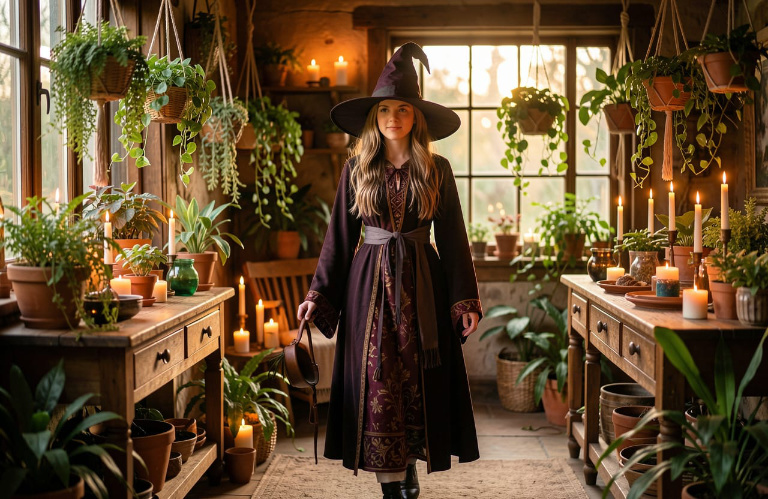
There’s a specific interior design aesthetic sometimes called “jungle home” that is, in practice, a map of where witches live. Every available surface has a plant on it. The windows are crowded with them. There are things hanging from the ceiling. Some of them are labeled. Some of them are unlabeled but you can feel the owner knows exactly what they are.
Plants are central to witchcraft in a way that’s hard to overstate. Folk magic traditions from virtually every culture on earth are built on plant knowledge — which herbs heal, which protect, which are used in ritual, which can be dangerous, which attract certain energies. This isn’t superstition divorced from reality; many of these plant properties are scientifically verifiable. The plants that were used for centuries to calm the nerves contain anxiolytic compounds. The ones used for wound healing contain antimicrobial properties. Witches figured this out the slow way, through observation and tradition, and maintained the knowledge.
For modern witches, houseplants carry both practical and energetic value. Some grow herbs for kitchen magic and cooking — rosemary, thyme, lavender, mint, basil. Some grow plants associated with protection or luck — spider plants, jade, aloe. Some just genuinely love plants and have discovered that caring for them is one of the most grounding and satisfying things a human can do. Tending to plants is slow, rhythmic, observational work. You have to pay attention. You have to be patient. You have to adjust to what the plant needs rather than what you want. That’s good practice for a witch and good practice for a person.
There’s also something that witches often describe as a quality of presence in plants — a sense that they’re responding, that they know when they’re being talked to, that the ones you care for especially seem to do better. Science is actually starting to catch up on this one; plant communication through chemical signals and root networks is a real and expanding field of research. But witches have been talking to their plants for centuries. They didn’t need the study.
11. Divination Tools — Tarot, Runes, Pendulums
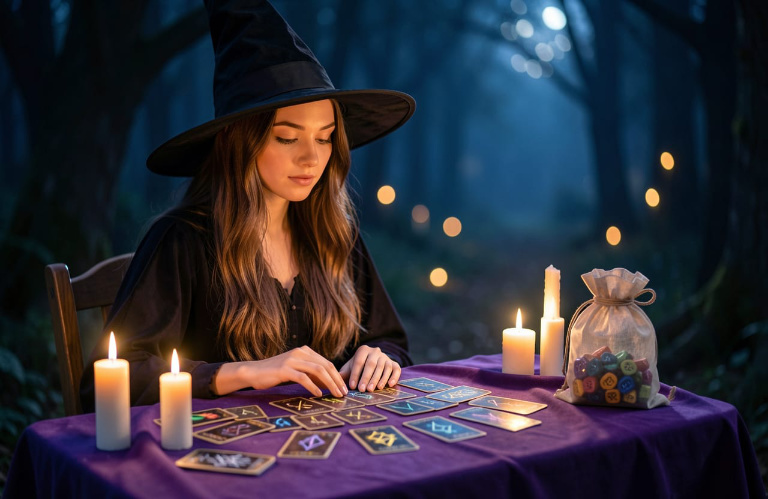
If there’s one thing that more than any other signals to the outside world that someone might be a witch, it’s the tarot deck. Or more accurately, the three tarot decks, one of which is being used, one of which is too beautiful to use, and one of which was a gift and has a very specific energy that’s not quite right yet but they’re working on it.
Tarot, along with runes, pendulums, oracle cards, tea leaves, scrying mirrors, and about a dozen other methods, falls under the umbrella of divination — the practice of seeking insight through symbolic interpretation. The way most witches actually use these tools is not about predicting a fixed future; it’s more like psychological archaeology. You shuffle a deck with a question in mind, draw cards, and then sit with the symbols. What do they reflect back about what you already know? What’s the thing you haven’t let yourself look at directly? Tarot is extraordinarily good at this, which is why Jungian therapists have been quietly interested in it for decades.
Daily tarot practice is extremely common among witches — pulling a single card in the morning to set a frame for the day, or pulling three cards to get a past-present-future read on something they’re sitting with. It’s not dramatic. It’s five minutes with a cup of tea and a deck of cards, and then you go to work. But those five minutes have a way of surfacing things. You pull the card that says something about isolation or fear or unexpected change, and instead of dismissing it, you sit with it, and something in you goes oh, right. And then you move through your day with that awareness.
Runes and pendulums work differently — runes are an elder system with roots in Norse and Germanic traditions, each symbol carrying a range of meanings that require genuine study. Pendulums are used for yes/no questions, the slight swing of the weight interpreted as a response. Both require practice and a willingness to be honest with yourself about what the response is saying, which is, honestly, the core skill in any form of divination. The tool is a mirror. What you see in it is always, in some way, already in you.
12. Liminal Times and Places
Witches are unusually fond of the in-between. Dusk. Dawn. The moment just before sleep when the mind starts wandering without permission. The edge where the forest meets the field. The shoreline, where the land becomes water. Crossroads. Thresholds. The first of a new season, exactly — the equinoxes and solstices, and especially the cross-quarter days in between.
Liminal is a word from Latin meaning “threshold,” and in folklore and magical traditions across the world, liminal times and places carry particular power. They’re the cracks between the regular rules, the moments when things that are normally separate are briefly touching. At dusk, it’s neither day nor night. At the shoreline, it’s neither land nor sea. At the crossroads, it’s neither here nor there. These ambiguous zones have been considered magically significant in virtually every culture that has left records, and witches haven’t let go of that understanding.
Practically, this means a witch is often the person who notices sunset while everyone else is still looking at their phones. Or who suggests a walk right at dusk specifically, or who lives near water and has a whole relationship with the tide. Liminal awareness is partly cultivated through practice, but partly it’s just temperament — some people are drawn to edges, beginnings, and endings. They feel more alive at those moments. They find something there that the middle of a regular Tuesday afternoon doesn’t have.
The eight sabbats of the Wheel of the Year — Samhain, Yule, Imbolc, Ostara, Beltane, Litha, Lammas, and Mabon — are all liminal moments in the solar calendar, and most witches celebrate them in some form. Even for those who don’t follow a formal calendar, there’s often an instinct around the solstices and equinoxes to do something to mark the turn. To acknowledge that the world is shifting, and to shift with it. Because not marking the transitions is, to a witch, a little like walking through a door without noticing it.
13. Animals — Especially the Unexpected Ones
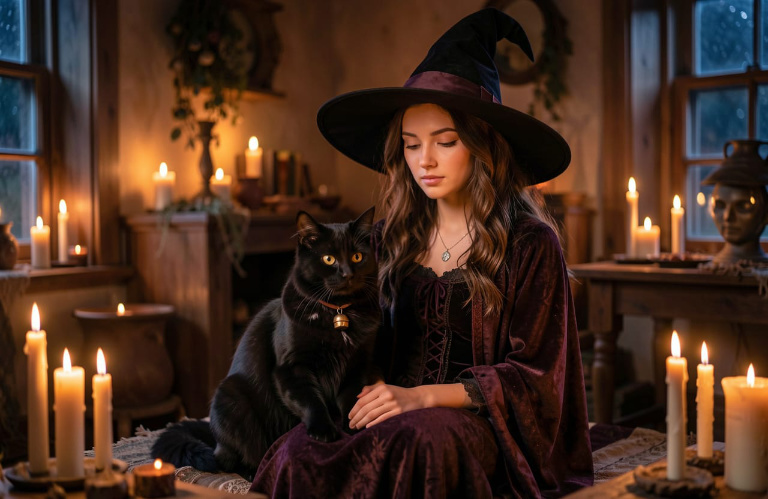
Every witch has a roster of animals they feel particular about. Not necessarily a familiar in the storybook sense (though some witches do maintain a specific relationship with an animal companion that goes beyond the standard pet dynamic). More often it’s just a marked attentiveness — to which animals appear at significant moments, to which ones seem drawn to them, to what the old stories and traditions say about each creature.
Animal symbolism and augury — reading meaning in the behavior and appearance of animals — is one of the oldest forms of divination. Before tarot and astrology and runes, there were birds flying overhead and what they meant. A crow at the window. An owl heard at night. A fox crossing your path. These weren’t superstitions to be explained away; they were a system of reading the messages moving through the natural world. Witches maintain this attention partly out of tradition and partly because the natural world does, in fact, seem to respond in interesting ways if you’re paying close enough attention.
There’s also a pattern in which witches tend to attract animals. The cat who follows them home. The wild bird that lands closer than it should. The spider who rebuilds in the same corner repeatedly and eventually gets left alone in peace. This could be selection bias — attentive people notice animals more and read meaning into moments others dismiss. But it could also be something about the quality of presence that comes with a practiced attention to the living world. Animals respond to stillness. They respond to people who are actually, genuinely noticing them rather than walking past.
Familiars, in the old sense, were spiritual companions — sometimes animals, sometimes other kinds of beings — who assisted in a witch’s work. In the modern sense, a familiar tends to mean an animal who has chosen you as much as you’ve chosen them, who seems uncannily aware of your emotional state, who shows up when they’re needed. Many people have had an animal like this in their lives. Witches just have a word for it. And they take that relationship seriously, as one of the most genuine partnerships a person can have with another creature.