

There’s something about wrapping your hands around a warm mug of tea that just feels like the world slows down a little. Maybe it’s the steam rising up, or the quiet ritual of waiting for it to cool just enough to sip. People have been doing this for thousands of years, and somewhere along the way, they started looking into the bottom of those cups and seeing things — stories, warnings, hopes, and answers. Tea leaf reading, or tasseography as it’s formally called, is one of the oldest and most intimate forms of divination there is, and it never really went away.
What makes tea leaf reading different from other mystical practices is how low-key and personal it feels. You don’t need a special room, a velvet tablecloth, or years of training. You just need tea, a cup, and a willingness to pay attention. The symbols that form in the leaves aren’t random — they’re a conversation between your subconscious, the universe, and the quiet moment you carved out for yourself. It’s divination for people who like their magic domestic and warm, the kind that happens in kitchens and living rooms, not just candlelit parlors.
Tea leaf reading peaked in popularity during the Victorian era, when it spread across Europe and became a beloved parlor tradition — especially among women who found in it a rare space for intuition and meaningful conversation. Grandmothers passed the practice to daughters, friends read for each other over afternoon tea, and the symbols became a shared language. That lineage is still alive. The practice carried through generations, tucked into family traditions and old handwritten notes, and right now it’s experiencing a real revival as people look for slower, more meaningful ways to connect with themselves and the world around them.
If you’ve ever felt curious about divination but didn’t know where to start, tea leaf reading is honestly one of the most approachable entry points you’ll find. It’s tactile, it’s cozy, it makes you sit still and actually look at something — which is rarer than it sounds these days. Whether you believe the leaves literally reveal the future or you see it more as a creative way to access your own intuition, the experience tends to surprise people. You end up saying things out loud, or noticing feelings you hadn’t named yet. That’s the magic, and it’s very real.
What Is Tea Leaf Reading and Where Did It Come From

Tea leaf reading goes back centuries, with roots in ancient China, the Middle East, and eventually spreading west along trade routes. As loose-leaf tea became common in European households in the 17th century, the practice of reading what was left behind in the cup traveled with it. By the 1800s it had become a cultural fixture, with dedicated books of symbols, professional readers, and a whole tradition built around the after-tea ritual of turning your cup over and looking for meaning.
The word tasseography comes from the French tasse (cup) and the Greek graphia (writing). Essentially — reading what’s written in the cup. Different cultures developed their own symbol systems and slightly different methods, but the core idea stayed the same: the pattern the leaves leave behind reflects something true about the person who drank the tea.
How Tea Leaf Reading Actually Works

The basic method is beautifully simple. You brew a cup of loose-leaf tea without using a strainer, drink it slowly while thinking about a question or just staying present, and then when just a small amount of liquid remains, you swirl the cup three times, turn it upside down on the saucer, let it drain, and flip it back over. What’s left clinging to the inside of the cup is what you read.
The cup is usually divided into sections that mean different things. The rim of the cup represents the present or near future. The sides represent events coming in the coming weeks or months. The bottom of the cup points to the more distant future, or sometimes to things that are foundational and deeply rooted in the person’s life. The handle of the cup typically represents the person being read for — so symbols near the handle are closer and more personal, while symbols on the opposite side might relate to other people or outside forces.
Reading Tea Leaf Symbols: The Language of the Leaves
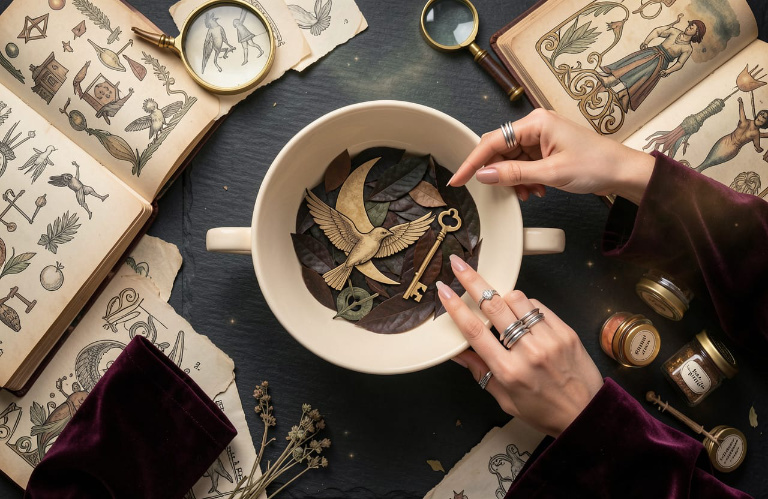
This is where it gets really interesting. The symbols that form in tea leaf reading aren’t an exact science — they’re more like a conversation. A bird near the rim could mean good news is coming soon. A snake might signal transformation or a warning to pay attention. A heart is usually pretty straightforward. Mountains can represent challenges ahead, but also achievement. Letters often refer to a person whose name starts with that initial.
The most important thing to know is that your first instinct matters most. When you look at a cluster of leaves and your gut says “that looks like a rabbit,” go with the rabbit before you talk yourself out of it. The intuitive hit is the point. Over time, readers develop their own relationship with certain symbols, and that personal meaning can be just as valid as any book definition.
Some of the most commonly seen tea leaf reading symbols and their traditional meanings include things like:
- Airplane — a journey coming, sometimes a sudden departure or big life change
- Anchor — stability, a safe arrival, something settling into place
- Apple — knowledge, health, a reward for hard work
- Arrow — direction, a message incoming, pay attention to which way it points
- Bee — community, hard work paying off, good news traveling fast
- Bell — an announcement, a wedding, something about to be revealed
- Butterfly — transformation, a light period coming after a heavy one
- Candle — clarity, enlightenment, someone helping you see the way
- Cat — mystery, independence, sometimes deception nearby
- Chain — a bond, commitment, sometimes feeling tied down
- Circle — completion, wholeness, something coming full circle
- Cloud — doubt, uncertainty, something not yet clear
- Crown — success, recognition, authority coming your way
- Cross — a challenge or burden, but also protection
- Dog — loyalty, a faithful friend, someone you can trust
- Door — a new opportunity, a choice between staying and going
- Egg — new beginnings, potential, something still developing
- Eye — pay attention, something is being revealed
- Feather — lightness, travel, a need to let something go
- Fish — good fortune, abundance, movement
- Flower — happiness, a blossoming relationship, good things growing
- Hourglass — time running out, a decision that can’t wait much longer
- Key — access, a solution appearing, unlocking something hidden
- Ladder — ambition, progress, climbing toward something better
- Moon — intuition, cycles, hidden emotions rising to the surface
- Mushroom — rapid growth, sometimes a situation expanding faster than expected
- Ring — commitment, a relationship, sometimes a literal engagement
- Star — hope, guidance, a wish with real staying power behind it
- Tree — growth, family roots, long-term stability
- Waves — emotional change, flow, something in motion
If you want, I can also sort them by theme (emotion, opportunity, warning, growth, etc.) or turn them into a printable cheat sheet for readings.
What Kind of Tea to Use for Tea Leaf Reading

Loose-leaf tea is essential — tea bags won’t work because the leaves are too fine and processed. Beyond that, you have real options. Traditional choices lean toward black teas like Earl Grey or Assam because they leave bold, easy-to-read deposits. Chinese oolongs are also popular and tend to produce interesting, varied shapes.
Herbal teas can work but tend to be trickier since the plant material varies so much in size and texture. Some readers swear by specific teas they’ve used for years and feel a personal connection to. If you’re just starting out, a good quality loose-leaf black tea in a wide, light-colored mug is your best setup — the contrast makes the symbols much easier to see.
How to Do a Tea Leaf Reading for Yourself

Getting started with tasseography at home is genuinely one of the more accessible divination practices out there. Here’s a simple way to do your first reading:
What you need: Loose-leaf tea, a teacup or wide mug with a light interior, a saucer, and a quiet moment.
Step one — brew with intention. Add about a teaspoon of loose-leaf tea directly to your cup, pour hot water over it, and let it steep. As it steeps, hold the cup and think about a question, a situation, or just set an intention to be open to whatever comes.
Step two — drink slowly. Sip the tea mindfully. It’s okay if a few leaves get in your mouth — that’s part of it. Leave about a teaspoon of liquid in the bottom.
Step three — swirl and turn. Swirl the remaining liquid three times clockwise, then turn the cup upside down onto the saucer. Let it sit for about a minute while the liquid drains away.
Step four — flip and look. Turn the cup right-side up and look at what the leaves have made. Don’t force it. Just look softly, the way you’d look at clouds. Let shapes emerge on their own.
Step five — interpret. Note what you see, where it is in the cup, and what your first feeling about it is. You can cross-reference a symbol guide, but always trust what the image means to you first.
Why Tea Leaf Reading Is Worth Coming Back To

In a world that moves fast and rewards certainty, there’s something quietly radical about sitting down with a cup of tea and asking an open question with no guaranteed answer. Tea leaf reading doesn’t promise to tell you exactly what’s going to happen. What it does do is slow you down, make you pay attention, and give you a structured way to access the feelings and instincts that usually get drowned out by noise.
A lot of people who come to tasseography skeptically end up returning to it — not necessarily because a leaf shaped like a fish predicted a financial windfall, but because the practice of sitting quietly, looking carefully, and speaking what you see out loud does something real. It surfaces thoughts. It creates reflection. It opens up conversations between people that wouldn’t have happened otherwise.
That’s what divination has always been at its best — not a cheat code for the future, but a mirror. And tea leaf reading is one of the warmest, most human versions of that mirror we’ve got.