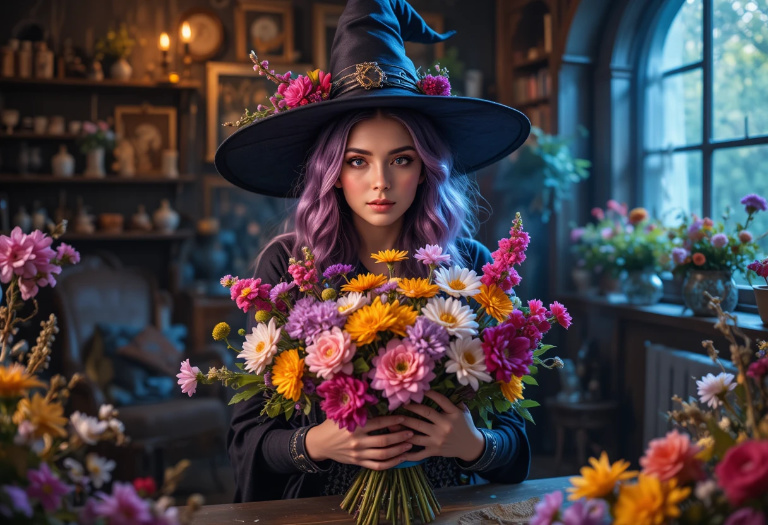
Long before texts and emails, people found ways to say things they couldn’t say out loud. In a world where the wrong words could get you burned, imprisoned, or worse, silence became a survival skill — but silence didn’t mean you had nothing to say. Witches, healers, herbalists, and wise women developed something far more subtle and far more beautiful: they let the flowers do the talking. A bouquet left on a doorstep wasn’t just a gift. It was a letter.
This secret language had a name — floriography — and it was taken very seriously. Every flower carried a meaning, and those meanings were understood by the people who needed to understand them. Lavender meant devotion. Rosemary meant remembrance. Foxglove was a warning. A woman who knew her herbs also knew her flowers, and she could string together a message as clearly as you’d write one on paper — except this one wouldn’t get her arrested. It would just sit quietly in a vase, smelling lovely, hiding everything.
What makes this so fascinating is that it wasn’t fringe or accidental. Floriography stretched across cultures and centuries, woven through folk magic, herbalism, and everyday life in ways most people never realized. The women who practiced it weren’t always called witches — sometimes they were the village midwife, the apothecary’s wife, the grandmother who always seemed to know things. They moved through the world carefully, and flowers gave them a language that was both completely open and completely invisible to anyone who didn’t know how to read it.
Most of that knowledge quietly slipped away. It got dismissed as superstition, lost in the gaps between generations, or simply forgotten when the world stopped needing secret codes in quite the same way. But it’s still there, buried in old herbals, folklore collections, and the stubborn memory of plants that have been growing the same way for thousands of years. This is the story of that forgotten language — and what the flowers were actually trying to say.
Every Flower Was a Word
The idea that flowers carry meaning is older than any one culture. Ancient Egyptians offered specific blooms to specific gods. Greek mythology tangled flowers up with transformation and feeling — narcissus, hyacinth, anemone, all of them carrying a story inside the petals. But the kind of intentional flower messaging that witches and wise women used most precisely? That grew strong in medieval Europe and reached its peak during the Victorian era, when floriography got its most detailed documentation.
By the time Victorian women were pressing flowers into books and passing coded bouquets back and forth, they were working from a tradition already centuries old. The flower meanings they used didn’t come from nowhere. They came from herbalists, folk healers, and the kind of women who had been quietly communicating through plants for generations before anyone thought to write it down properly.
What the witches were drawing on was something called sympathetic magic — the idea that a plant’s physical qualities, its smell, its color, the way it grows, all carry a kind of spiritual signature. That signature didn’t just make the plant useful for spells. It made it useful for meaning. A thorned plant meant difficulty or protection. A climbing plant meant ambition or reaching. Something that bloomed in darkness meant things meant for secrecy. The whole natural world was a vocabulary, and flowers were the most expressive part of it.
The Most Important Flowers in the Secret Language
Rosemary — Remembrance and Warning
Rosemary is one of the oldest magical plants in the world, and its meaning has barely shifted in two thousand years. “Rosemary for remembrance” shows up in Shakespeare, in folk songs, in wedding traditions and funeral rites. It was placed on graves and tucked into wedding bouquets. Witches used it for memory spells, for protection, and for communication across distances — the idea being that rosemary strengthened a psychic or emotional bond between two people.
But rosemary in a bouquet also carried a warning: I remember what you did. It was the kind of message you sent to someone who had betrayed you, quiet and fragrant, sitting on their kitchen table until they figured out what it meant. There was power in that.
Lavender — Devotion, Luck, and Hidden Love
Lavender has always been a protective flower. Hung above doorways, tucked into pillowcases, burned as incense — it kept bad spirits out and brought calm in. In the secret flower language, lavender meant devotion and deep feeling, the kind that didn’t need to be announced. A bundle of lavender left for someone was a declaration of love that stayed quiet enough to be deniable.
Wise women grew lavender for practical reasons — it healed, it cleaned, it repelled insects — but they also grew it because a flowering lavender plant by your door was a message to those who could read it: this is a protected house. That’s the kind of dual meaning that made floriography so powerful. The flower worked on every level at once.
Foxglove — The Dangerous One
Foxglove is stunning, tall, and deeply poisonous. Every part of it can kill you. It was called witch’s glove and dead men’s bells and fairy thimbles, and the names alone tell you what people understood about it. In folk belief, foxglove belonged to the fairies, and to use it, you were borrowing from something old and not entirely safe.
In flower messaging, foxglove meant a warning. It meant I know what you’re capable of. Sent between two people who understood the language, it was a declaration of power — not a threat exactly, but a reminder. A woman who grew foxglove in her garden was a woman you didn’t cross carelessly. The flower said it for her, all summer long.
Yarrow — Healing and Courage
Yarrow is a humble little flower, white and clustered, easy to miss. But it’s one of the oldest medicinal plants in human history — there’s evidence of yarrow in Neanderthal burial sites, which tells you something about how long people have understood its value. It stopped bleeding, reduced fever, eased pain. In flower language, it meant healing, courage, and love that endures hardship.
A bunch of yarrow sent to someone sick was both practical and magical — it was medicine and it was a message. I’m thinking of you. I’m pulling for you. This will pass. That’s the kind of communication that made the flower language feel less like a code and more like a true language. It had warmth in it.
Mugwort — Dreams and Prophecy
Mugwort doesn’t look like much. It’s scraggly, silver-leafed, a little wild. But in the world of folk magic, mugwort was one of the most important plants a witch could have. It was burned before divination, drunk as a tea to bring vivid dreams, placed under pillows to invite prophetic sleep. It was a plant for seeing things that weren’t visible in ordinary daylight.
In the flower language, mugwort meant I’ve been dreaming about you — which, in a magical context, was not a small thing. Dreams were a form of communication, a channel between people and between the living and the dead. To tell someone you’d dreamed of them was to say that the connection between you was strong enough to cross into sleep. It was intimate in a way that ordinary words couldn’t quite match.
Read More Flowers
Belladonna — Power and Illusion
Belladonna, also called deadly nightshade, is one of the most mythologized plants in witch history. It’s genuinely dangerous — the berries look edible and aren’t, and the whole plant contains alkaloids that cause hallucinations, racing heart, and in high doses, death. Witches were said to use it in flying ointments, rubbed into the skin to induce visions. Whether that’s literally true or not, the plant’s association with altered states and hidden power is ancient and consistent.
In flower messaging, belladonna meant things are not what they seem. It was a warning about deception — either that the sender suspected it, or, more coldly, that the sender was capable of it. A woman who included belladonna in anything she sent was announcing that she understood the difference between surface and depth, and that she was operating on both levels at once.
Wormwood — Absence and Bitterness
Wormwood is silvery, sharp-smelling, and intensely bitter. It’s the plant that gives absinthe its edge and its reputation. In folk magic it was burned to summon spirits, used in divination, and placed at doorways to keep unwanted things out. The smell alone is enough to make the air feel charged with something older than ordinary life.
Its flower meaning was tied directly to its taste: bitterness, absence, something lost that isn’t coming back. Sending wormwood was a way of saying I know what’s gone between us. It wasn’t always hostile — sometimes it was honest grief, an acknowledgment of a separation that hurt. But it was never soft. Wormwood didn’t soften anything.
Vervain — Enchantment and Protection
Vervain was one of the most sacred plants in the ancient world. The Romans called it herba sacra and used it to purify altars. Druids revered it. In folk magic across Europe, vervain was a plant of pure protection — worn as an amulet, hung in homes, carried by travelers. It was also tied to love magic, to binding, to the kind of enchantment that doesn’t let go.
In the flower language, vervain meant you are protected or, in a more charged context, you are bound to me. That dual meaning — protection and enchantment being two sides of the same coin — made it one of the more complicated flowers to send. Receiving vervain from someone who loved you was a gift. Receiving it from someone you’d wronged was something else entirely.
Henbane — Trance and Forgotten Things
Henbane is a strange, sticky-leaved plant with pale flowers veined in purple. It smells unpleasant, it’s highly toxic, and it has been associated with witchcraft longer than almost any other plant. It was found in the bag of a Viking sorceress buried over a thousand years ago. It shows up in medieval witch trial records constantly. It causes confusion, sedation, and in larger amounts, a total break from ordinary reality.
In flower messaging, henbane meant forgetting — specifically, the kind of forgetting that’s imposed rather than natural. It suggested that something was being concealed, that memory itself was being interfered with. Receiving henbane in a bouquet was unsettling by design. It was a plant that said: someone is working to make you not see clearly.
Elderflower — The Fairy Threshold
The elder tree was deeply sacred in British and Northern European folk tradition. Cutting one down without asking permission was considered genuinely dangerous. The Elder Mother — a spirit said to live inside the tree — needed to be spoken to, appeased, acknowledged. The flowers, which bloom in wide, lacy clusters and smell sweet and slightly heady, were associated with the boundary between this world and the fairy world.
In the flower language, elderflower meant a threshold is near or something is shifting between worlds. It was used in messages about death, about major life transitions, about moments when the ordinary rules didn’t apply. A healer who included elderflower in a gift to a dying person was saying something about the journey ahead — not with grief, but with the calm of someone who understood that the border between here and there was not as solid as it looked.
Mandrake — Deep Magic and the Unconscious
Mandrake is the plant that entire chapters of magical history have been written around. The root, which can look vaguely humanoid, was considered one of the most powerful magical tools available. It was used in love spells, in protection, in rituals for fertility and power. The legends around it — that it screamed when pulled from the ground, that the scream could kill — tell you everything about how seriously people took it.
In flower messaging, mandrake meant this goes deeper than you know. It was a signal that the situation — or the relationship — had roots that weren’t visible on the surface. Sending mandrake was an invitation to go deeper, to stop taking things at face value. It was the kind of message that required the recipient to already understand a great deal in order to receive it properly.
Rue — Regret and Purification
Rue is a bitter herb with small yellow flowers and a sharp, distinctive smell. Shakespeare gave it to Ophelia, which tells you something about its emotional weight. It was called the herb of grace, associated with repentance and the clearing of spiritual contamination. Witches used it to break hexes, cleanse spaces, and cut connections that had gone bad.
In the flower language, rue was one of the clearest messages you could send: I’m sorry or this is over and I’m clearing the air. It was also used to tell someone that you believed they’d been cursed or spiritually compromised — that something around them needed cleaning out. Either way, rue in a bouquet was serious. It didn’t get sent lightly, and it didn’t get received lightly.
Chamomile — Patience and Resilience
Chamomile looks completely harmless — small white daisy-like flowers, apple-sweet smell, the thing you drink when you’re anxious. And in many ways its flower meaning matches that gentle face: it meant patience, calm, the ability to survive difficulty. But there’s a tougher side to chamomile in the magical tradition. It was known as a plant that thrived under pressure — the more you walked on it, the better it grew.
That made it a message of resilience rather than mere gentleness. Sending chamomile to someone in trouble said: you will not be broken by this. It was encouragement from someone who understood hardship, not comfort from someone who didn’t. There’s a difference, and the women who used this language knew it.
Deadly Nightshade’s Cousin — Bittersweet Nightshade — Truth Mixed with Pain
Where belladonna spoke of pure illusion, its less lethal relative bittersweet nightshade carried a more complicated message: truth that costs something. The berries start green, turn yellow, and ripen to red — a visible display of transformation — and the plant is both mildly toxic and medicinally used in small doses. It sits in that uncomfortable middle ground between harm and healing.
In flower messaging, bittersweet nightshade meant what I’m about to tell you is true, and it will hurt. It was the flower you sent before a difficult revelation, a softening that also warned. A wise woman who needed to tell someone something they didn’t want to hear might include it in a bundle — not to cause harm, but to signal: I know this is bitter. I’m not hiding that it is.
Valerian — Sleep, Peace, and Hidden Depth
Valerian flowers are small and pale pink, almost delicate. The root smells like old socks, but the flowers are lovely, which is its own kind of metaphor. The plant was used for centuries as a sedative, for treating anxiety and insomnia, for calming people who were at the edge of themselves. It was also used to attract cats, which in magical tradition had its own significance.
In the flower language, valerian meant rest now or what’s keeping you from peace? It was a compassionate message, but also occasionally a challenging one. Sending valerian to someone who refused to deal with their own exhaustion was a gentle push. In magical communication, it could also mean I know what’s beneath your surface — because the plant’s sweetness on top and its strong, unsettling smell underneath made it a natural symbol for hidden depths.
Mint — Virtue and Warming
Mint is one of those plants so common it gets underestimated. But in magical and folk traditions, it was a serious herb — used in healing, in prosperity spells, in communication magic. Hermes, the messenger god, was associated with it. The Greek myth that mint was once a nymph named Minthe, transformed by Persephone out of jealousy, gave it a charged erotic undercurrent that its clean, bright smell doesn’t immediately suggest.
In flower messaging, mint meant virtue or moral warmth — the kind of goodness that’s active, not passive. It could also mean I’m thinking of you in the sense of communication across distance, keeping the channel between two people alive. A small bundle of mint was a low-stakes message, something like sending someone a quick note just to say you hadn’t forgotten them. Warm and uncomplicated on the surface, with older layers underneath if you knew to look.
Pennyroyal — Flee and Protect Yourself
Pennyroyal is a small-leafed, strongly scented member of the mint family that carries a much darker history. It was known as a powerful emmenagogue — something that stimulates menstruation — and was used historically by women to end unwanted pregnancies, sometimes fatally. Healers and wise women handled it with real caution, knowing exactly how powerful it was.
In flower messaging, pennyroyal was one of the most urgent signals you could send: get out or protect yourself now. It implied danger, particularly danger aimed at a woman’s body or autonomy. Receiving pennyroyal wasn’t a message you ignored. Women in communities who understood the language knew that pennyroyal appearing in a bundle meant something serious was happening, or about to.
Hemlock — You Have Gone Too Far
Hemlock is most famous for killing Socrates, which tells you something about how long people have understood what it does. It grows tall and hollow-stemmed with white flower clusters that look innocuous from a distance — it’s been mistaken for edible plants, which is part of what makes it so dangerous. In folk magic, hemlock was rarely used by good-intentioned practitioners. It lived at the darker edge of the tradition.
In flower messaging, hemlock meant a clear and final warning: you have crossed a line and there are consequences. It wasn’t sent out of spite — sending hemlock was a serious act, not a petty one. It announced that the sender understood what hemlock was, that they were not naive or powerless, and that what had happened between them and the recipient had reached a point of no return. It was the last message before silence.
St. John’s Wort — Protection Against Darkness
St. John’s Wort blooms around the summer solstice, which is part of why it became so deeply embedded in midsummer magic traditions across Europe. Hanging it above doors on Midsummer’s Eve was said to keep witches and evil spirits out — which creates an interesting situation where the very plant witches used was also supposed to protect against them. That kind of paradox was completely normal in folk magic, where power didn’t belong to one side.
In the flower language, St. John’s Wort meant I am protecting you from what’s in the dark. It was a flower of active, vigilant care — not gentle comfort but deliberate shielding. Sending it to someone was saying that you were aware of threats they might not see, and that you were working on their behalf. In communities that took magical threat seriously, that was a significant offer.
Columbine — Foolishness and Abandoned Love
Columbine is a beautiful flower — distinctive, multi-petaled, almost architectural in how it’s built. But its symbolic meaning was more melancholy than its appearance suggested. In the language of flowers it was associated with foolishness, with love that had been abandoned or betrayed, with the kind of feeling that made someone vulnerable in ways they later regretted.
In the folk magic tradition, columbine was used in spells meant to release attachments — to cut the emotional ties that kept someone stuck in a relationship or situation that had ended. Sending columbine was an honest message: this is finished and we should both acknowledge it. It wasn’t cruel. It was clear. And clarity, in the world of secret flower language, was its own kind of mercy.
Thyme — Courage and Fairy Connection
Thyme was a plant of courage in the medieval tradition — knights wore it into battle and ladies embroidered it onto their favors. It was also, in British folk belief, strongly connected to fairies. Patches of wild thyme were considered fairy resting places, and disturbing them was unwise. Bees love thyme, and bees in magical tradition were messengers between the human world and the spirit world.
In the flower language, thyme meant I see your bravery or, in a more magical register, the unseen world is paying attention to you. It was a flower of recognition — sent to someone who had done something difficult, who had shown a quality that needed acknowledging. In the context of wise women’s communities, where courage was often quiet and unrecognized by the wider world, thyme was a meaningful tribute.
Poppy — Sleep, Forgetting, and the Dead
Poppies are where sleep and death meet in the flower world. Their association with fallen soldiers, with Remembrance Day, with the sleep that comes before death — all of that grew from something much older. In Greek mythology, poppies were sacred to Demeter and to the underworld. The opium poppy’s properties made the connection between poppies and altered states, sleep, and the loosening of consciousness completely literal.
In the flower language, poppies meant rest with the dead or I am remembering someone gone. They were grief flowers, but also flowers of acceptance — the recognition that forgetting was sometimes a kindness, that sleep was sometimes what was needed. A wise woman sending poppies to someone in mourning was not just expressing sympathy. She was acknowledging that grief eventually needed to soften into something livable, and that the dead deserved to be remembered with some peace.
Holly — Defense and the Fierceness of Protection
Holly looks beautiful and draws blood if you grab it carelessly, which is more or less its entire personality. It was considered one of the most powerfully protective plants in Northern European tradition — hung above doors to keep out harmful spirits, kept in homes through winter when other green things had died. Its association with midwinter and the returning sun made it a plant of endurance, of surviving darkness.
In flower messaging, holly meant fierce protection — not the gentle kind, but the kind with teeth. Sending holly said: I will defend what matters to me and you should know that. It was a plant that announced boundaries clearly. Women who kept holly in their gardens were signaling something to those who understood it: that this was a protected space, that harm directed at it would meet resistance, and that the protection came from somewhere deep and serious.
Hawthorn — The Boundary Between Worlds
Hawthorn is one of the most magically charged trees in Celtic and British tradition. It blooms in May, which is why May blossom is another name for it, and bringing hawthorn flowers indoors was considered deeply unlucky — a boundary was being crossed that shouldn’t be. It was a tree of liminal space, growing at the edges of fields, at boundaries between properties, at places where the human world and the spirit world thinned.
In the flower language, hawthorn meant be careful where you step. It was a message about boundaries — literal or spiritual — that were dangerous to cross without awareness. Wise women used it to mark the edges of protected spaces, and sending it to someone was a signal that they were approaching a threshold that required care. Not a threat, exactly. A navigation note. Here be edges. Watch yourself.
Mugwort’s Night Companion — Black Hellebore (Christmas Rose) — Scandal and Powerful Secrets
Black hellebore blooms in winter, sometimes through snow, with dark-veined white flowers that look like something that shouldn’t be alive at that time of year. It was used historically to treat mental illness, to induce sleep, and in more dangerous hands, to poison. Its winter blooming made it a plant of darkness and hidden things — things that grew when most of the world was dormant and not paying attention.
In the flower language, black hellebore meant there are things here that don’t come out in daylight. It suggested scandal, powerful secrets, things known to the sender that weren’t widely known. Including it in a bouquet was a quiet announcement of awareness — that the sender knew something, or that the situation contained depths most people couldn’t see. It was the flower of the person who watched carefully and said little, and whose silence was itself a kind of power.
How the Messages Were Built

A single flower could say one thing. But a bouquet could tell a whole story, and that’s where the real skill came in.
The way flowers were combined carried meaning. The way they were tied — loose or tight, with specific herbs tucked between the blooms — added layers. Even which hand you held the bouquet out with mattered in some traditions. Given with the right hand, the meaning was straightforward. Given with the left, it was reversed or shadowed.
Color added another dimension. Red flowers meant passion or urgency. White meant purity or mourning, depending on context. Yellow was complicated — sometimes friendship, sometimes jealousy, sometimes a caution against something. Purple carried spiritual meaning, a connection to mystery and the unseen. A wise woman choosing her flowers wasn’t just picking what was pretty. She was choosing what she needed to say.
There were also flowers you didn’t include. An absent flower could speak as clearly as a present one. If you sent a bouquet to someone who expected lavender — devotion — and it wasn’t there, that absence said something. The people communicating this way understood the grammar of it, the way you’d understand that a missing word changes a sentence’s meaning entirely.
Why Witches Needed a Secret Language
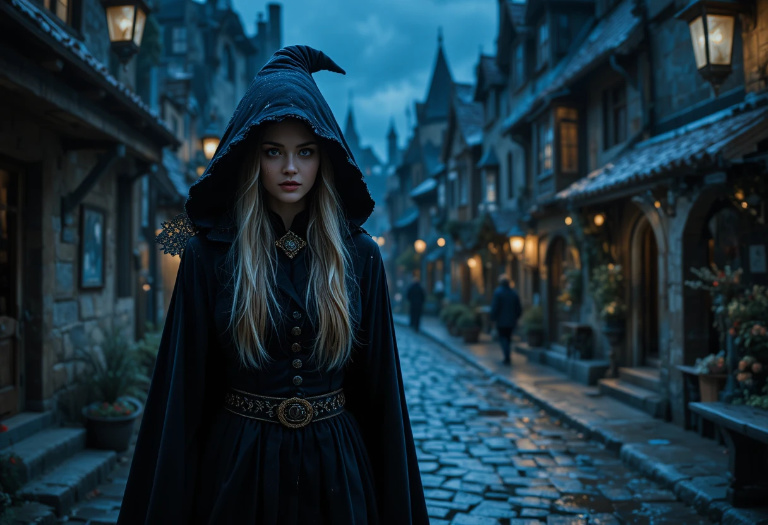
This is the part worth sitting with: why did this language exist? Why go to all that trouble?
The answer is simple and painful. For much of European history, a woman who knew too much about plants was dangerous. A woman who healed people was a competitor to the church and to male physicians who didn’t like the competition. A woman who seemed to know things she shouldn’t know, who people visited at night with their problems, who kept a garden full of strong-smelling, strange-looking things — that woman was a target.
The witch trials that swept through Europe from the 1400s into the 1700s killed tens of thousands of people, most of them women, most of them accused of things that amounted to being herbalists, midwives, or simply unconventional. In that climate, coded communication wasn’t romantic or whimsical. It was protective. A flower language meant you could exchange information, offer support, send warnings, declare allegiances — and if someone found the bouquet, it was just a bouquet.
Even outside of active persecution, women in these periods had remarkably little power over their own voices. What they could say, to whom, and in what setting was tightly controlled. Flowers gave them something else. A channel that was always open, always available, always beautiful enough that nobody looked at it too hard.
The Victorian Revival
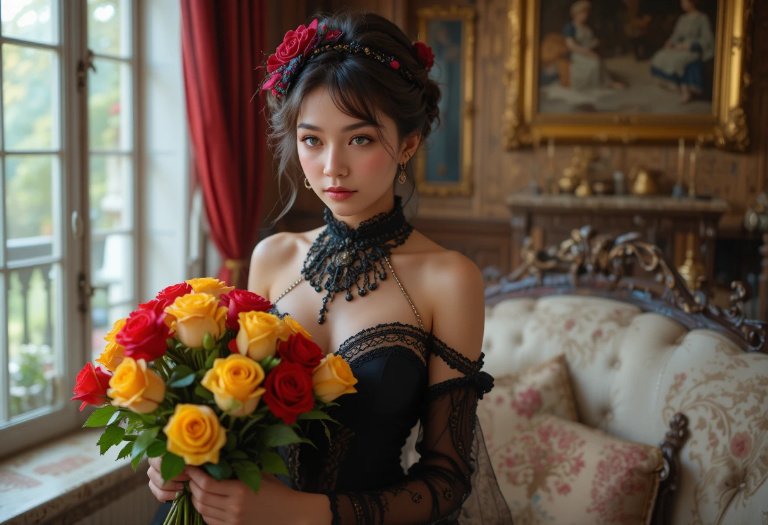
By the 1800s, the world had changed enough that floriography could come out of the shadows — at least partly. The Victorians were obsessed with it. They published flower dictionaries, printed charts, gave each other elaborate tussie-mussies (small, structured bouquets) as tokens of feeling. What had been a survival language for wise women became a fashionable pastime for middle-class ladies.
But underneath the Victorian drawing-room version, the older meanings were still there. The flowers hadn’t changed what they were. Rosemary still meant memory and warning. Foxglove still meant power and danger. Women who knew the older tradition — and there were still women who knew it — were reading a different layer of meaning than the polite society version acknowledged.
That’s the magic of a living tradition. It adapts. It goes underground when it has to, and it resurfaces when conditions allow. The Victorians thought they were being charming and fashionable. Some of them were. Others were continuing something much older and sending very specific messages through their bouquets, just as their grandmothers had done, and their grandmothers before them.
The Language Lives On
You can still find versions of this language alive in folk magic communities, in hedge witch traditions, in the work of modern herbalists who take plant relationships seriously. People still leave rosemary at graves. People still grow lavender by their doors. People still press flowers into letters and gifts, reaching for something that feels more significant than a text message.
There’s a reason this keeps coming back. Flowers are alive in a way that words on a screen aren’t. They smell, they change, they die. They carry time inside them — the season they grew in, the soil they came from, the hands that tended them. When you give someone a flower, you’re giving them something that was once wild, something that grew without asking permission. That has weight to it.
The women who built this language understood that. They worked with what the world gave them — beauty that was also useful, meaning that was also deniable, communication that was also protection. They built something elegant out of necessity, and then the flowers kept growing long after the names of those women were forgotten.
The next time someone hands you a bouquet, it’s worth asking: what are the flowers actually saying? The language is still there. It’s just waiting for someone who knows how to read it.