

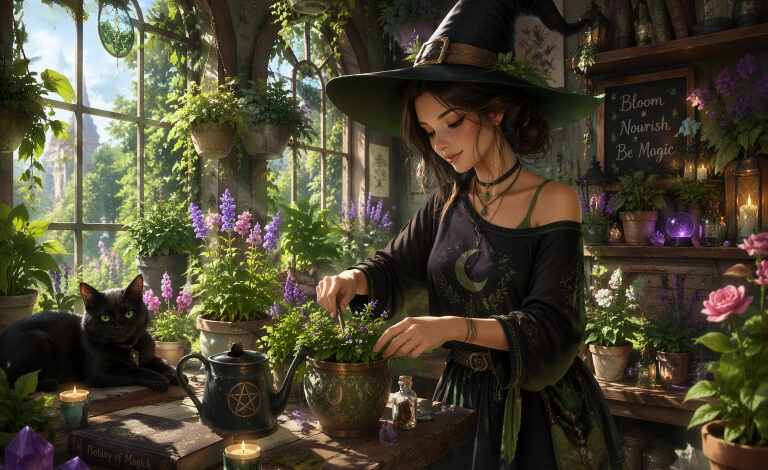
You’ve done it. Maybe you were alone, maybe you checked over your shoulder first, but at some point you leaned toward your pothos and said something like “you’re doing so good” or “okay, drama queen, why are you drooping like that.” And then you probably laughed at yourself, because talking to plants is supposed to be the punchline of a joke about eccentric aunts and overly devoted gardeners. Except here’s the thing nobody tells you: the joke is on the people who stopped doing it.
Long before “plant parent” became a hashtag, cultures all over the world treated plants as beings worth speaking to — not metaphorically, not as a cute habit, but as an actual relationship with give and take. Witches, herbalists, and folk healers didn’t whisper to their rosemary because they were bored. They did it because plants were understood as collaborators: entities with their own consciousness, their own preferences, and their own way of answering back if you knew how to listen. Somewhere between the industrial revolution and the invention of the fluorescent grow light, we forgot that plants were ever considered anything more than green furniture.
This article is an invitation to remember. We’re going to look at why talking to your plants isn’t just charming nonsense — there’s real science nodding along in the background — and then we’re going to go further, into the practice of treating your houseplants as spirits with personalities, moods, and their own quiet magic. No incense required, no dramatic altar, no need to quit your day job and move into a greenhouse. Just you, a watering can, and a windowsill full of beings who have been waiting patiently for you to say hello.
“Do Plants Actually Listen?”

Let’s get the skeptic-baiting question out of the way first: can plants hear you? The honest answer is complicated, and that complication is exactly what makes this so fun. Plants don’t have ears, obviously, but researchers studying plant bioacoustics have found that certain plants respond measurably to sound and vibration — adjusting root growth toward the frequency of running water, for instance, even when no water is actually present. Vibrations from chewing insects have been shown to trigger some plants into releasing defensive chemicals before a single bite has landed on their leaves. That’s not folklore. That’s a plant sensing something in its environment and reacting with intention.
Then there’s the underground gossip network scientists call the “wood wide web” — the vast mycorrhizal fungal threads that connect tree roots to one another, allowing them to share nutrients, send warning signals about drought or disease, and even support struggling neighbors. A forest, it turns out, is less like a collection of individuals and more like a conversation that’s been happening for centuries, most of it in a language we’re only beginning to translate. If trees can talk to trees, the leap to “maybe my fern notices when I talk to it” doesn’t feel so far-fetched anymore.
None of this proves that your snake plant understands English, and no credible scientist is claiming plants are eavesdropping on your day and forming opinions about your ex. But that’s not really the point. The point is that plants are far more responsive, sensitive, and aware of their environment than the “decorative object” model ever gave them credit for. Witchcraft has always lived comfortably in that gap between what science has confirmed and what it hasn’t yet ruled out — and this is prime real estate for exactly that kind of magic.
Green Familiars: Plants as Spirit Companions

In folk magic traditions, a familiar isn’t just a black cat perched dramatically on a windowsill — it’s any being that works alongside a practitioner, offering companionship, insight, and a kind of quiet power-sharing. Plants have held this role for as long as anyone’s been keeping records. Rosemary was planted by doorways not for the smell alone but as a guardian, a green sentinel with its own protective will. Basil was kept in kitchens as much for luck and cleansing as for pesto. These weren’t passive ingredients waiting to be harvested; they were considered active participants in the household’s wellbeing.
Animist traditions — the belief that spirit or consciousness isn’t unique to humans but runs through animals, water, stones, and yes, plants — offer a useful lens here even if you don’t consider yourself animist. Under this framework, your monstera isn’t a thing you own so much as a being you’re in relationship with. It has its own rhythms, its own likes and dislikes about light and touch and attention, and its own way of contributing to the energy of a room. Treating a plant as a spirit companion means shifting from “I am maintaining this object” to “we are cohabitating, and I owe this being some consideration.”
This doesn’t require you to believe your fiddle leaf fig has a soul in the theological sense. It just asks you to extend the kind of respect you’d give any living thing that shares your space and depends on you — while allowing for the possibility that the relationship goes both ways. Practitioners who work with plant spirits often describe a genuine shift once they start treating their plants this way: more attentiveness, more patience with a plant that’s struggling, and honestly, plants that seem to do a little better once someone’s actually paying attention. Correlation or magic — you get to decide, and either answer works.
How to Actually Talk to a Plant (Without Feeling Like a Weirdo)

The hardest part of this practice usually isn’t believing in it — it’s getting over the self-consciousness of doing it out loud. Start small. You don’t need a ceremonial voice or special words; you just need to talk the way you’d talk to a friend who can’t talk back but is clearly listening anyway. Morning watering is a natural entry point, since you’re already there, already paying attention. A simple “good morning, how are we doing today” while you check the soil is plenty. The goal isn’t performance, it’s presence.
Tone matters more than content. Plants that thrive under conversation tend to belong to people who speak gently, consistently, and without rushing — which suggests the benefit may have as much to do with the slowing down as the specific words used. Try narrating what you’re doing as you do it: “I’m going to turn you a little so this side gets some sun too,” or “this leaf’s looking a little sad, let’s see if more water helps.” It sounds silly written down. It feels completely different once you’re standing there doing it.
And then — this is the part people skip — leave room for silence. Talking to a plant isn’t a monologue, it’s supposed to be a practice of attention, and attention requires pauses. After you speak, stand there for a moment. Notice the plant. Notice the light hitting it, the way its leaves are angled, whether it seems to be leaning toward or away from you. You’re not necessarily waiting for a voice to answer. You’re training yourself to actually see the plant in front of you, which, it turns out, most of us almost never do.
Reading the Room: How Plants “Talk Back”

If talking to plants is one half of the conversation, learning to read their responses is the other — and this is where the practice gets genuinely interesting. A droop isn’t always a cry for water; it can be a plant telling you it’s overwhelmed by too much sun, or that the soil is compacted and it can’t breathe. Leaves curling inward can be a request for more humidity, while yellowing lower leaves are frequently just a plant’s way of saying “I’m done with this one, let it go, focus your energy elsewhere.” Learning these signals isn’t so different from learning a partner’s moods — you get better at it the longer you pay attention, and the plant starts to feel less like a mystery and more like someone you know.
New growth deserves particular attention in this framework, because it’s arguably the clearest “yes” a plant can offer. A fresh leaf unfurling, a new shoot reaching toward light — these are moments of genuine responsiveness, evidence that whatever you’re doing (the talking, the care, the attentiveness) is being met with something. Practitioners who work closely with their plants often start marking these moments almost like small conversations reaching a resolution: you asked something of the relationship, and the plant answered by growing.
Scent, too, is a form of communication most people overlook entirely. A plant that suddenly smells stronger — the sharp green scent of a bruised tomato leaf, the peppery bite of disturbed basil — is releasing compounds in direct response to something happening to it, whether that’s stress, damage, or simple contact. Learning to notice these cues, rather than only checking in when something looks visibly wrong, turns plant care from a reactive chore into an ongoing dialogue. You start to catch the whispers before they become shouts.
Choosing Your Plant Spirit Guide

Not every plant offers the same kind of companionship, and part of the fun of this practice is learning to recognize personality. Cacti and succulents tend to read as the self-sufficient, slightly sarcastic friends of the plant world — low-maintenance, unbothered, perfectly happy to be ignored for two weeks and then judge you slightly when you finally show up with the watering can. If you’re someone who forgets to check in on yourself too, a cactus can be a strangely good teacher in boundaries and self-reliance.
Ferns, on the other hand, carry an older, quieter energy — the wise elder of the houseplant world, sensitive to their environment, unwilling to thrive under neglect or harsh conditions, but deeply rewarding once you learn their rhythms. Working with a fern often teaches patience and consistency, since they tend to sulk dramatically at the first sign of dry air or inconsistent watering, then reward steady care with lush, feathery abundance. Pair a fern with someone building a daily ritual practice, and you’ve got a genuinely good match.
Then there’s the fiddle leaf fig, the reigning drama queen of plant spirits — gorgeous, moody, prone to dropping a leaf if you so much as look at it wrong, and utterly incapable of being ignored. Pothos and philodendrons, by contrast, are the easygoing best friends: forgiving, adaptable, happy to trail wherever you let them, the kind of plant spirit that’s perfect for beginners still building confidence in this practice. Part of choosing a plant spirit guide is honest self-reflection — are you looking for a teacher who challenges you, or a companion who simply keeps you company while you figure the rest out?
Rituals & Practices

Naming your plants is a small act that changes the entire relationship, and it’s worth taking seriously rather than treating as a joke. A name is an acknowledgment of individuality — this isn’t “the pothos,” it’s Bartholomew, and Bartholomew has his own personality distinct from every other pothos in the world. Once a plant has a name, people report noticing it more, tending to it more consistently, and feeling genuinely bad about neglecting it in a way that “the plant on the shelf” never quite triggers.
A simple “first hello” ritual is worth doing with every new plant that enters your home, whether it arrived from a nursery, a cutting from a friend, or a rescue from the clearance shelf. Sit with the new plant for a few minutes before you do anything else — no repotting, no immediate watering, just presence. Introduce yourself, tell it where it is now and that it’s safe, and take a moment to notice its current state: the soil, the leaves, any stress it might be carrying from the move. This isn’t about performing magic so much as marking a beginning, the way you’d take a moment before starting any new relationship.
Moon-watering — giving plants water that’s been left out under moonlight, particularly the full moon — is a practice with deep folk roots, tied to the belief that moonlight carries its own subtle energy that plain tap water lacks. Whether or not you buy into the energetic component, the ritual itself is valuable: it builds a rhythm of intentional care tied to a natural cycle rather than a random Tuesday. Pair this with small gratitude practices — a quiet thank-you after harvesting herbs, an acknowledgment when a plant blooms — and repotting or propagation days start to feel less like chores and more like rites of passage, moments where you and the plant are both doing something a little vulnerable together.
When Plants Grieve (and What That Teaches Us)
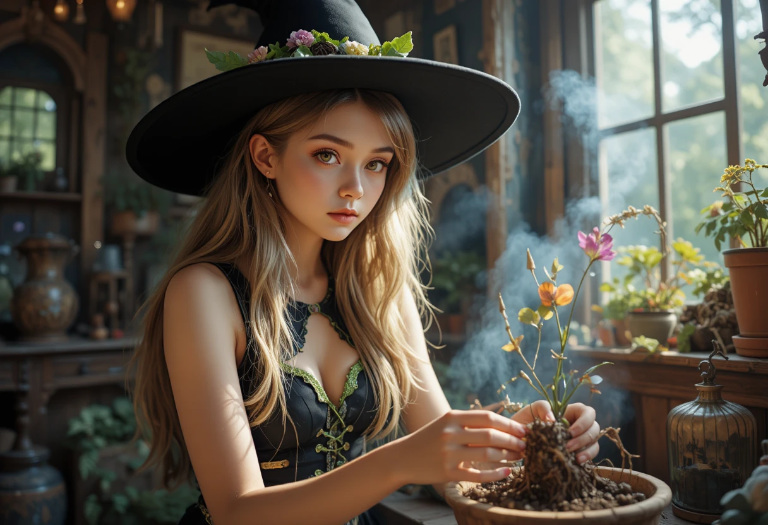
Eventually, and it will happen no matter how devoted a plant parent you become, a plant will decline, and some will die. This is the part of the practice most articles skip, because it’s uncomfortable, but it might be the most honest section here. A dying plant isn’t a failure to be hidden in shame — it’s the natural end of a relationship that had a beginning, a middle, and now an end, the same as any other bond worth having. Treating that ending with the same attention you gave the living plant is part of what makes this a genuine spiritual practice rather than a hobby you drop the moment it stops being pretty.
There’s something quietly instructive about watching a plant let go of a leaf it can no longer support, redirecting its energy toward what still has a chance. It’s a small, plant-scaled lesson in triage and acceptance that’s easy to miss if you’re only checking your plants for “problems” rather than actually watching them. Practitioners who sit with a dying plant rather than immediately discarding it often describe learning something about their own relationship to loss — the instinct to look away, to move quickly past discomfort, versus the harder practice of staying present until the end.
When a plant does die, consider marking it rather than simply tossing it in the compost without a thought. Returning its remains to soil — whether in your garden, a potted new plant, or even a single symbolic handful — closes the loop in a way that feels respectful of what the relationship gave you. This isn’t about performative grief for a houseplant; it’s about practicing the muscle of acknowledging endings honestly, a skill that tends to serve people well far beyond the windowsill.
A Simple Daily Practice to Start Today

You don’t need to overhaul your morning routine or buy a single new object to begin this practice — you just need five unhurried minutes and a plant that’s already living in your home. Start tomorrow: walk over to whichever plant catches your eye first, and actually look at it before you touch anything. Notice the soil, the leaves, the direction it’s leaning. Say good morning. Ask how it’s doing, out loud if you can manage it, silently if you can’t quite get there yet.
Water if it needs water, but don’t make that the point of the visit — the point is the noticing, the small greeting, the pause before you rush off to the rest of your day. Do this daily, even briefly, and you’ll likely notice two things happening at once: your plants, responded to consistently, tend to visibly thrive, and you, forced into sixty seconds of genuine stillness each morning, tend to feel a little steadier too. That’s the whole practice, really. It was never about proving plants can hear you. It was about remembering how to pay attention to something quietly alive.
Say Good Morning Anyway
We started this piece with the image of talking to a houseplant and immediately feeling silly about it — and it’s worth returning to that moment now, because the silliness was never really about the plants. It was about how disconnected we’ve become from the idea that attention itself is a kind of care, and care is a kind of magic, whether or not you dress it up in ritual language. Witches have known this for as long as there have been witches: the ordinary, repeated, unglamorous act of showing up for another living thing is where the real power lives.
Your pothos was never going to answer you in words, and that was never really the point. The point was standing there long enough to notice it in the first place — really notice it, the way you’d notice a person you loved. So go ahead and say good morning to Bartholomew tomorrow. Nobody’s watching. And even if they were, you’d be in extremely good, extremely old company.