


Think about the one relationship that still makes your chest tighten when you remember it. Maybe it’s an ex who broke you open in ways you’re still healing from. Maybe it’s a parent, a sibling, a friend who turned into a stranger overnight. Whoever it is, you’ve probably asked yourself the same question a hundred times: why did this happen to me? What if the answer isn’t random at all? What if that person walked into your life because your soul asked them to?
This is the idea behind a soul contract — an agreement made before you were even born, long before either of you took physical form. In this belief, souls don’t just bump into each other by accident. They plan things out. They choose the hardest lessons, the messiest heartbreaks, and the people who will deliver them, because pain teaches in ways comfort never could. Your most painful relationship might not be a mistake or bad luck. It might be the exact lesson your soul signed up for.
In this article we’re going to unpack what a spiritual contract really is, why souls choose painful bonds instead of easy, peaceful ones, and how to recognize the fingerprints of a contract in your own life. By the end, you might look back at your hardest relationship with a little less bitterness — and a lot more understanding.
What Exactly Is a Soul Contract?
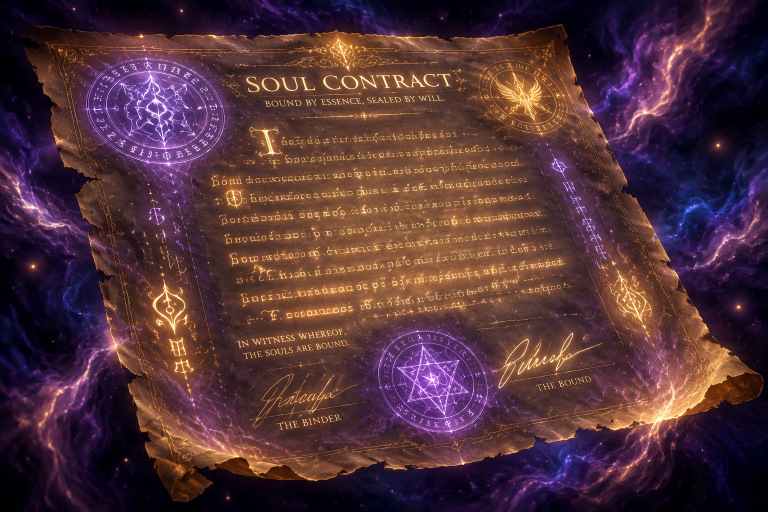
A soul contract is basically a spiritual agreement made between souls before they’re born into this life. Picture it like a meeting that happens on the other side, before any of the noise of the physical world gets in the way. Two souls sit down, so to speak, and agree on what they’re going to help each other work through this time around. One soul might agree to show up as a controlling parent so the other can learn boundaries. Another might agree to become a heartbreaking lover so the other can finally learn self-worth.
It sounds strange at first, especially if you’re only used to thinking of relationships in terms of chemistry, timing, or compatibility. But soul contracts flip that idea completely. They suggest that the hardest people in your life were chosen on purpose, by you, for reasons your conscious mind can’t remember. The forgetting is actually part of the plan — if you remembered the deal going in, the lesson wouldn’t hit the same way.
Why Souls Choose Pain Over Peace

Here’s the part that trips people up the most: why would any soul choose suffering? Wouldn’t it make more sense to plan out a life full of ease?
The belief is that growth doesn’t usually come from comfort. Comfort keeps you exactly where you are. Pain, on the other hand, forces movement. It cracks you open. A soul that wants to grow quickly, that wants to master patience, forgiveness, boundaries, or self-love, often chooses relationships that will push those exact buttons — hard.
So the parent who never validated you may have been a soul agreeing to teach you how to validate yourself. The partner who betrayed you may have been a soul offering you the chance to learn discernment and trust your own gut. It’s not that these people are “bad souls.” In this framework, they’re doing sacred, difficult work on your behalf, even while causing you real pain. Painful roles are, in a strange way, roles of deep love.
The Different Types of Soul Contracts

Not every painful relationship carries the same kind of contract. A few common types tend to show up again and again:
The Mirror Contract — This soul reflects back your own wounds so clearly it’s almost unbearable. If you struggle with abandonment, you might attract someone who constantly threatens to leave, forcing you to face that fear head-on instead of running from it.
The Catalyst Contract — This person’s entire role is to blow up your life as you know it. A sudden breakup, a shocking betrayal, a friendship that ends in flames — these relationships aren’t meant to last. They’re meant to shake you out of a stagnant path and push you toward a completely different direction.
The Karmic Contract — Some believe certain relationships carry unfinished business from a past life. The tension you feel with someone you just met, the instant animosity or magnetic pull that makes no logical sense, may be an old debt finally coming due for repayment or resolution.
The Teacher Contract — This soul comes in specifically to teach you one major lesson, then exits once that lesson is learned. These relationships often feel intense but short-lived, ending abruptly the moment the growth has happened, almost like the job is done.
Signs You’re in a Contracted Relationship

Certain patterns tend to show up when a relationship is more spiritual assignment than accident:
- The connection feels instant and intense, almost too strong for how little time you’ve known each other.
- The relationship keeps circling back to the same lesson, over and over, no matter how many times you try to avoid it.
- You feel a strange sense of familiarity with someone, like you’ve known them before, even on a first meeting.
- The relationship ends the moment you finally learn what it was trying to teach you — almost like clockwork.
- Despite the pain, some part of you feels the relationship was necessary, even sacred.
If any of that sounds familiar, it’s worth asking: what lesson was this soul really here to deliver?
How to Work With Your Contract Instead of Against It

Recognizing a soul contract doesn’t mean you have to stay in a relationship that hurts you. In fact, once the lesson is learned, staying often blocks your growth rather than helping it. The goal isn’t to suffer forever — it’s to notice the pattern, absorb the lesson, and let the relationship complete its purpose.
A few ways to work with this energy:
- Ask what the lesson is, not just what the pain is. Instead of “why is this happening to me,” try “what is this teaching me?”
- Release blame without releasing boundaries. You can understand someone’s soul-level role in your life while still protecting yourself from continued harm.
- Say a quiet thank-you, even through gritted teeth. Gratitude, even forced, tends to speed up the release of painful ties.
- Watch for the release point. Many contracted relationships end almost the second the lesson lands. If it feels like a door is closing, let it.
When the Contract Is Complete, Let It Close

Every soul contract has an expiration date. Once the growth has happened, once the lesson has been absorbed into who you are, the relationship tends to loosen its grip on its own. That doesn’t mean the pain wasn’t real, or that what happened was okay. It means the assignment did its job.
Your most painful relationship may not have been a punishment. It may have been one of the most important agreements your soul ever made — a hard, necessary, love-shaped push toward becoming who you were always meant to be. The next time you think back on that person, try holding both truths at once: it hurt, and it mattered. Sometimes that’s exactly what a soul contract looks like.