
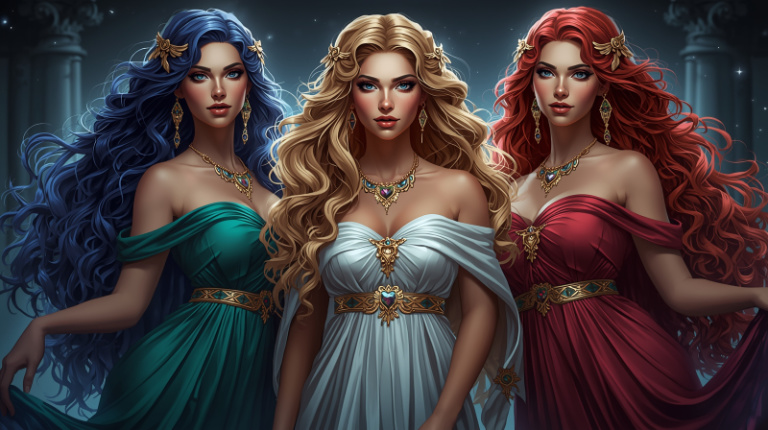
Long before there were writing apps, mood boards, or motivational podcasts, there were nine women who ran the whole operation. They lived on Mount Helicon and later Mount Parnassus, daughters of Zeus and Mnemosyne — the goddess of memory — and their job was to breathe life into human creativity. Poets prayed to them before putting a single word down. Musicians called on them before ever touching an instrument. If your work was good, people said a Muse had touched it. If it was bad, well, maybe you just weren’t listening.
The ancient Greeks took these nine seriously. They weren’t decorative figures painted on a vase for atmosphere. They were forces — real, present, and specific. Each one owned a particular kind of art or knowledge, and each one had her own symbol, her own energy, her own way of showing up. Together they covered basically everything that made life worth living: song, story, dance, comedy, tragedy, history, love poetry, astronomy, and the sacred hymn.
What’s interesting is how modern this all feels. We still talk about “the muse” when something clicks for an artist. We still say a piece of music was “inspired” — and that word, inspire, literally means to breathe into. The Greeks weren’t being poetic when they said a muse whispered in your ear. They meant it. The inspiration you feel at 2am when an idea suddenly arrives fully formed? That’s her. That’s always been her.
This is the story of all nine of them — who they are, what they carry, and what kind of spark each one is willing to hand you if you’re open enough to receive it.
1. Calliope — Muse of Epic Poetry

Calliope is the oldest and most powerful of the nine, and she knows it. Her name means “beautiful voice,” and she is the one Homer called on at the opening of the Iliad and the Odyssey. When humans needed to tell the biggest stories — wars, heroes, gods, the fate of entire civilisations — they came to her. She carries a writing tablet and stylus, always ready, always watching, waiting to see if you have the stamina for something grand.
Her gift isn’t just about writing long things. It’s about scale. Calliope is the muse you feel when a small personal story suddenly reveals something enormous and universal underneath it. She takes what is human and makes it mythic. She’s the reason a war story becomes a meditation on grief, or a road trip becomes a quest for meaning. She deals in permanence — the kind of work that outlasts its maker.
She also inspires the kind of discipline epic work demands. Nobody writes an epic in an afternoon. Calliope is the muse of the long game — the years-long project, the commitment to a vision that hasn’t fully revealed itself yet. She rewards the writer who shows up even when the words aren’t coming, who trusts the structure even when it feels impossible.
If you’ve ever felt called toward something ambitious — a project that scares you a little, that feels bigger than you — that’s Calliope putting her hand on your shoulder. She doesn’t choose the comfortable path. She chooses the ones willing to go the distance.
2. Clio — Muse of History

Clio holds a scroll and a set of books, and her name means “to make famous” or “to celebrate.” She is the keeper of what actually happened — the muse who insists that the past is not gone but alive, full of lessons, full of people who lived and struggled and figured things out before we ever arrived. She is the reason we need to know where we came from before we can understand where we’re going.
Her inspiration comes quietly, often through curiosity. She’s the one behind the feeling you get when you fall down a rabbit hole of research and surface hours later, stunned by what you found. She governs the impulse to document, to preserve, to bear witness. Journalists, historians, archivists, documentary filmmakers — all of them are working under her influence, whether they know it or not.
Clio also gives us perspective. When everything feels overwhelming and unprecedented, she is the muse who reminds us it isn’t — that people have faced worse and built their way back. She hands us context like a gift. She shows us that the stories of the dead are still speaking, still offering maps, if we’re willing to listen carefully enough.
What Clio really inspires is reverence — a respect for time and for the people who moved through it before us. She pushes us to ask better questions: Who was here? What did they know? What did we almost forget? If you feel pulled toward history, genealogy, storytelling rooted in the real — Clio is the reason. She believes nothing should be lost.
3. Erato — Muse of Love Poetry

Erato’s name comes from Eros, the god of love, and she owns the territory everyone secretly cares most about. She holds a lyre and wears a crown of roses, and she is the muse behind every love song that ever made someone pull over a car to hear it properly. She inspires the poetry of longing, desire, connection, and heartbreak — everything that makes love the most written-about subject in human history.
Her gifts are intimate and electric. She’s the muse behind the text you couldn’t stop yourself from sending, the song that felt like it was written specifically about your life, the poem scrawled at 3am that somehow said the thing perfectly. Erato deals in vulnerability. She takes the feelings too large and too tender to speak aloud and gives them a form — something that can be held, read, sung, heard.
But Erato isn’t only about romance. She governs all forms of deep human longing — the ache for connection, for beauty, for closeness with another person or place or idea. She turns the private into the shared. She is the reason that when you read certain lines of poetry, you feel less alone. That recognition — someone else felt this too, and found the words for it — that’s entirely her doing.
If your creativity lives closest to your feelings, if your best work comes out of your most personal experiences, Erato is your muse. She doesn’t ask you to be cool or detached. She asks you to be honest, to go right to the centre of the feeling and stay there long enough to make something true.
4. Euterpe — Muse of Music

Euterpe means “she who delights,” and her domain is music — specifically the lyric kind, the song-like, flute-playing, melodic kind. She is depicted with a flute called the aulos and is often surrounded by nymphs. She is pure sound, pure feeling translated into pattern — the muse behind every melody that arrives out of nowhere and won’t leave your head until you’ve written it down.
Her inspiration is physical before it’s intellectual. Music lives in the body first — in the chest, in the feet, in the hands. Euterpe’s gift is the ability to feel sound as meaning, to hear emotion in a chord change, to know instinctively when something is right. She’s behind the goosebumps, the involuntary tears, the impulse to turn the volume up because the song just hit different today.
She also inspires musicians who are searching — who are listening to everything, absorbing everything, trying to find their sound. Euterpe is generous with influence. She doesn’t guard genre boundaries. She moves between folk and jazz and classical and whatever comes next, carrying the same basic truth: music is one of the oldest technologies humans have for communicating things that words can’t quite reach.
If you make music, or if music moves through you in a way that sometimes feels like a language you already know, Euterpe put it there. She has been doing this longer than writing has existed. She was the first muse humans ever called on — before the story, before the poem, there was the song.
5. Melpomene — Muse of Tragedy
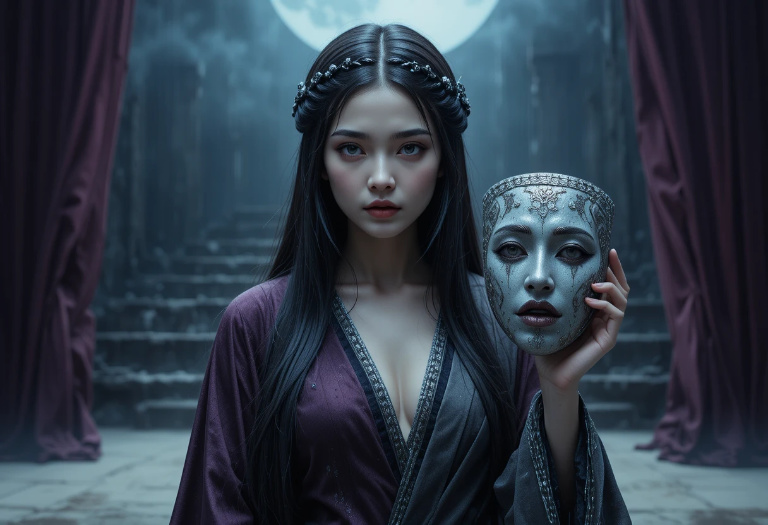
Melpomene wears a tragic mask and carries a knife or a club — symbols of the fates that bring suffering into the story. Her name means “the one who sings,” but what she sings is the sorrow at the heart of great drama. She is the muse behind every story that breaks you open. Every film that leaves you sitting in the credits, unable to move. Every piece of literature that makes you grieve characters who never existed.
Her gift is the gift of catharsis — the Greek word for the emotional release that comes from witnessing tragedy safely, through art. She teaches us that suffering can be made into something beautiful. Not in a way that minimises it, but in a way that honours it — that says this pain matters, this loss means something, this human life was worth mourning. Melpomene is the muse behind art that takes the hard things seriously.
She inspires the storyteller who doesn’t flinch. The playwright who gives the villain a reason. The novelist who lets the character they love most fail anyway, because it’s true, because it’s human. Melpomene doesn’t want easy endings or false resolution. She wants stories that feel like they earned their weight — that leave the audience changed, not just entertained.
To be touched by Melpomene is to feel the full gravity of being alive. She is the muse for anyone whose art reaches toward the difficult, the real, the irreversible. She believes — and she is right — that the most honest art is often the most heartbreaking, and that heartbreak, witnessed and shared, is one of the things that connects us most deeply to each other.
6. Polyhymnia — Muse of Sacred Poetry and Hymns

Polyhymnia is the quiet one. She is often shown with a finger pressed to her lips, draped in white, standing in stillness. Her name means “many songs” or “many hymns,” and she governs the sacred — the music and poetry written in devotion, in reverence, in the search for something beyond the ordinary. She is the muse behind the hymn, the chant, the prayer set to music, the meditation.
Her inspiration is the kind that comes in silence. Polyhymnia doesn’t shout. She whispers, and only to those who have been still enough to hear her. She is the muse behind the impulse to reach toward the divine through creative work — to write or compose something as an act of gratitude, of surrender, of awe. The spiritual quality in certain music, the sacred feeling in certain poetry — that is Polyhymnia doing what she does.
She also inspires rhetoric and oratory — the art of the well-chosen word in service of something larger than the speaker. The speech that moves a crowd. The sermon that opens a heart. The lecture that makes an idea suddenly luminous. Polyhymnia cares about language that carries weight, that is spoken with intention, that serves a purpose beyond the ego of the one speaking.
What she really inspires is devotion — the kind of creative practice that is about something more than recognition or success. If you make things quietly, consistently, not always for an audience but because it feels necessary, because it feels like an offering — Polyhymnia is your muse. She has always preferred depth to volume, and meaning to fame.
7. Terpsichore — Muse of Dance

Terpsichore holds a lyre and is usually depicted mid-movement, like she was caught in the middle of a step. Her name means “she who delights in dancing,” and her domain is the body in motion — the art form that requires no medium except the human form itself. She is the muse behind every dancer who moves so well it looks like they’re speaking a language, behind every choreographer who arranges bodies in space to tell a story.
Her gift is the translation of feeling into movement. Terpsichore is the muse who knows that the body knows things the mind doesn’t, that grief has a shape, that joy has a rhythm, that the deepest emotions sometimes only release when the body is allowed to express them. She is behind the impulse to dance when no one is watching — the private, unchoreographed movement that is pure and honest because nobody is performing for anyone.
She also inspires the chorus — the collective movement, the ritual gathering of bodies in a shared physical language. From ancient Greek drama (where the chorus danced as it narrated) to modern concert halls, sporting events, religious ceremonies, dance floors — Terpsichore is present wherever people move together in intentional, meaningful ways. She believes that community lives in the body as much as in the mind.
If you are someone who thinks with your body — an athlete, a dancer, a yogi, an actor — Terpsichore is familiar to you. She is the reason movement sometimes feels like expression. She’s the muse who never once cared whether you were technically trained or not. She only cares whether you mean it.
8. Thalia — Muse of Comedy

Thalia wears a crown of ivy and carries a comic mask and a shepherd’s crook. She is light where Melpomene is dark, and together they form the complete picture of human drama. Her name means “to flourish” or “to bloom,” and her domain is comedy — not just jokes and laughter, but the whole tradition of storytelling that finds joy, absurdity, and human warmth even in the messiest situations.
Her gift is perspective. Thalia is the muse who shows you the ridiculous side of the serious — who reminds you that dignity is always one banana peel away from collapse, and that this is not a tragedy but a relief. She inspires the comedian, the satirist, the playful novelist, the person at the dinner table who can find the funny angle on the worst week of their life. Laughter, she knows, is not avoidance. It’s a form of courage.
Thalia also governs pastoral poetry — idyllic, nature-rooted, simple, grounded work. She reminds us that not everything needs to be weighty or profound. Some art is about delight — about the pleasure of a well-constructed joke, the warmth of a story that ends well, the comfort of beauty that isn’t trying to change your life. Thalia makes space for the light things, and she considers them just as important as the heavy ones.
If you have ever made someone laugh through their tears, or found humour as a way to say something true that couldn’t be said seriously — that’s Thalia. She is the muse who believes joy is not shallow. She has always known that laughter is one of the bravest things a human can do.
9. Urania — Muse of Astronomy

Urania stands apart from the others in an interesting way — she looks upward. She holds a globe and a compass, and her domain is the sky, the stars, the planets, and the mathematics that makes sense of all of it. Her name means “heavenly” or “of the sky,” and she is the muse behind the impulse to understand the cosmos, to map it, to find pattern and meaning in the movement of celestial bodies.
Her inspiration is the vertigo that comes from looking up. The feeling on a clear night when you really register the size of the sky and for a moment your problems seem both unbearable and weightless at the same time. Urania governs that feeling — the one that is equal parts awe and terror, the one that makes you feel small and significant all at once. She is the muse behind every human who has ever pointed at the stars and needed to understand what they were pointing at.
She also connects beauty to mathematics, which is one of the oldest and most underrated human insights. The night sky is not just beautiful — it is ordered, measurable, full of elegant structure. Urania inspires the scientist who sees poetry in data, the astronomer who is also an artist, the mathematician who finds the universe genuinely moving. She is proof that logic and wonder are not opposites.
If you are drawn to the big questions — not just what but why, not just how but what does it mean — Urania is your muse. She deals in the largest possible scale. She is the muse of perspective, the patron of anyone who has ever felt that understanding something deeply is its own form of reverence.